 (Zachary Meseck Photo)
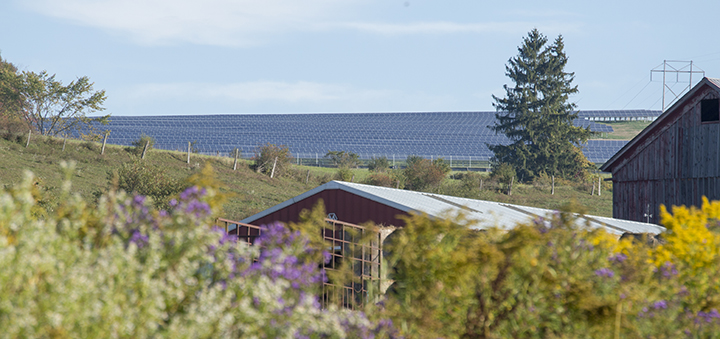
NORWICH – One of the largest solar farms in New York State is nearly finished in the Town of Norwich, after less than three months of intensive work by hundreds of local contractors.
According to Solomon Community Solar LLC CEO Jeffrey Mayer, to commemorate and to recognize town officials, contractors and workers, Solar Farms New York, the facility’s developer, plans a ceremonial groundbreaking at the site for 2 p.m. on Monday afternoon, September 23, at 5021 State Route 23 in Norwich.
Mayer said once connected to the NYSEG grid and energized the project will supply enough electricity to operate over 2,000 average-sized homes in upstate New York.
“The Norwich farm will make a significant contribution in the state’s push to achieve 100 percent renewable electricity by 2040,” said Mayer. “This could not have happened without the joint efforts of dozens of people and we wanted to honor them in person."
The Norwich facility covers 79 acres owned by the Evans family and consists of over 50,000 stationery panels on a slight rise that faces southwest.
Town of Norwich Supervisor David Evans owns the farm where the solar project is being built.
The supervisor explained his land was part of the lease when the project was first proposed, and he recused himself from the decision making process.
“They hope to have the project finished by early fall. This is a great thing for our area and county. It is clean energy and will add more to a small tax base,” said Evans in July.
"I haven't seen any solar farm built faster than this one, anywhere," said Mayer. "The weather conditions were ideal, the contractors did an excellent job and got everything up quickly."
He said the community solar project will also benefit local governmental entities in the form of payments in lieu of property taxes. He added that approximately $1,415,000 will be paid to the Town of Norwich over the life of the project, which is scheduled to be 20 years long.
According to Mayer, it's entirely possible that after the 20 year contract, another contract with the customers, town, and utilities may be signed, extending the original one.
"The manufacturer warranties assure the buyers that the panels will degrade no more than half a percent per year over 20 years, meaning that over the 20 years, the panels can be expected to produce at around 90 percent or more," said Mayer. "On top of that, each municipality asks for a decommissioning bond, so after the time is up, if they're no longer interested in renewing a contract, they have the money to clear the area."
He said when compared to all of the other industry waste, like cars, trucks, and other objects that end up rusting and sitting in a dump for years, solar panels are an efficient technology that don't require oil or grease, create their own energy, and will last an average of 40 to 50 years. He added that as technology improves, its possible for solar panels to become even more efficient and last even longer.
"Solar is a remarkable technology, nothing compares to it," said Mayer. "There are used solar panels all over the world in off grid locations like Africa and in Asia creating power for people in need."
"When connected to the NYSEG grid, the panels in this project will produce about 20 million kilowatt hours of electricity per year and will offset at least 20,000 tons of carbon dioxide each year."
He reported that the solar panels offset 12 times as much carbon as an acre of mature trees would absorb in a year.
"The two biggest objections we receive when we reach out to people about this concept are, 'I've been hosed by my ESCO in the past, why would I trust you now,' and 'It's too good to be true, why would an organization give me free access to sign up, to be a member, and to cancel?'" said Mayer. "The reality is that the five percent credit that we're offering people here stem from New York State and it's drive to get the state to 100 percent renewable energy – that's why its happening and its so easy to get involved."
Mayer explained that all NYSEG customers will receive more renewable energy as soon as the project is electrified. “Electrons go into the grid where they benefit all NYSEG customers,” he said, “But only our members who join the farms will get the monthly savings that the farms produce.”
He said that unlike rooftop solar any NYSEG customer can become a member whether they own or rent.