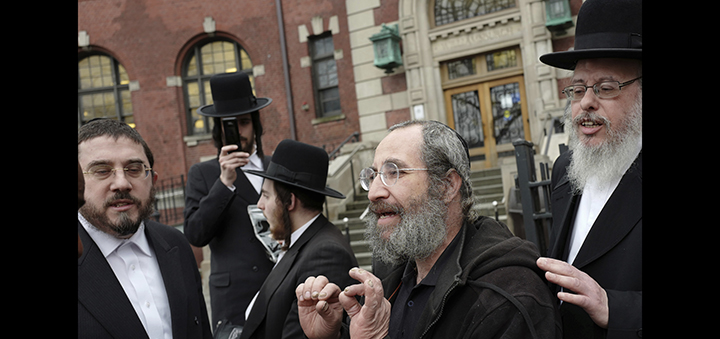
Links photo. With AP Photos.
NEW YORK (AP) — New York City declared a public health emergency Tuesday and ordered mandatory vaccinations for measles in a part of Brooklyn that is home to a large Orthodox Jewish community.
The city took the unusual step amid a surge of 285 measles cases in the city since September, most in one densely packed neighborhood where people now have to get vaccines or risk a $1,000 fine.
In the U.S., the Centers for Disease Control and Prevention reported there have been 465 cases so far this year, two-thirds of them in New York state. That compares to 372 cases in the U.S. for all of last year. Besides New York, there have been outbreaks this year in Washington state, California. Michigan and New Jersey.
The disease was declared eliminated in the U.S. in 2000, which means it was not being spread domestically.
But cases have been rising in recent years, in part the result of misinformation that makes some parents balk at a crucial vaccine.
Most of the reported illnesses are in children. The CDC says roughly 80% of the U.S. cases are age 19 or younger.
Here are some questions and answers about measles:
Q: How dangerous is measles?
A: Measles typically begins with a high fever, and several days later a characteristic rash appears on the face and then spreads over the body. Among serious complications, 1 in 20 patients get pneumonia, and 1 in 1,000 get brain swelling that can lead to seizures, deafness or intellectual disability.
While it’s rare in the U.S., about 1 in every 1,000 children who get measles dies, according to the CDC.
Q: How does it spread?
A: By coughing or sneezing, and someone can spread the virus for four days before the telltale rash appears.
The virus can live for up to two hours in the air or on nearby surfaces. Nine of 10 unvaccinated people who come into contact with someone with measles will catch it. Dr. Anthony Fauci, infectious disease chief at the National Institutes of Health, recently called it “one of the most contagious viruses known to man.”
Q: Is a problem outside of the U.S.?











