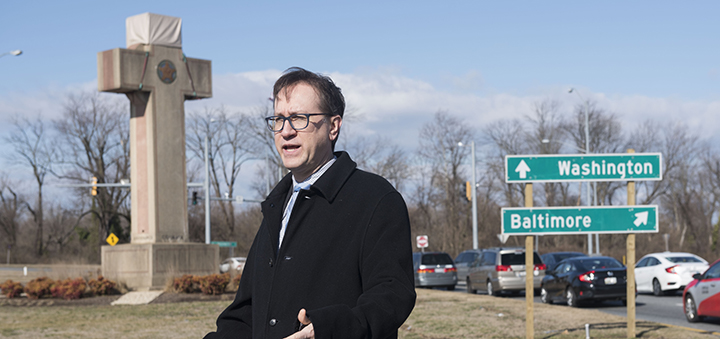
BLADENSBURG, Md. (AP) — Steven C. Lowe says he has always thought that a 40-foot-tall (12-meter-tall) concrete cross that stands on a large, grassy highway median near his home was odd.
For years, he says, he didn't know that the cross in Bladensburg, Maryland, is a war memorial. A plaque on the cross' base lists the names of 49 area residents who died in World War I, but it isn't easily read from the road and getting to the monument requires dashing across traffic. Lowe said he felt the cross implied that the city where it stands favored Christians over others.
"It certainly made me raise my eyebrows," said Lowe, 68, who is retired from the telecommunications industry.
In 2014, Lowe, two other area residents and the District of Columbia-based American Humanist Association, a group that includes atheists and agnostics, sued to challenge the cross. They argue that the cross' location on public land violates the First Amendment's establishment clause, which prohibits the government from favoring one religion over others. The group lost the first round in court, but in 2017 an appeals court ruled the cross unconstitutional. Now, the cross' supporters are asking the Supreme Court to overturn that ruling in a case the justices will hear Wednesday.
The memorial's supporters would seem to have a good shot based on the court's decision to take the case and the court's more conservative makeup, seen as more likely to uphold such displays. Plus, even liberal Justice Stephen Breyer voted in a 2005 case to uphold a Ten Commandments display on public property.
Backers of the nearly 100-year-old cross, also called the "Peace Cross," say if the justices rule against them it could threaten hundreds of monuments nationwide. Opponents, for their part, say few memorials are truly similar. They argue the cross should be moved to private property or modified into a nonreligious monument such as a slab or obelisk, a suggestion backers say would be desecration.
Arguing for the cross at the high court are The American Legion, which raised money for the cross and completed it in 1925, and officials with the state of Maryland, which took over managing the site in 1960. They have the support of the Trump administration and 30 states.
Supporters say the cross is a fixture of Bladensburg, Maryland, just about 5 miles from the Supreme Court. Traffic reporters use it as a reference point in radio reports. Residents give directions that refer to it.
Maryland officials argue that the cross doesn't violate the Constitution because it has a secular purpose and meaning, honoring veterans, in an area where several other memorials to veterans stand. On the other side, the American Humanist Association says that using a cross as a war memorial doesn't make the cross secular; it makes the war memorial Christian.
Similar monuments have met with a mixed fate at the high court. On the same day in 2005, for example, the court upheld a Ten Commandments monument on the grounds of the Texas state capitol while striking down Ten Commandments displays in Kentucky courthouses. Justice Breyer, whose vote made the difference in the outcome in both cases, said the history of the courthouse displays demonstrated a government effort to promote religion while the Texas display had a primarily nonreligious purpose.