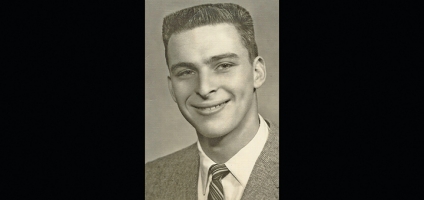
Tom Dixon
Contributor
Patrick Michael Quinn was born Feb. 24, 1940 in Norwich, NY, the oldest of three children to Frank and Mary Quinn. This post-depression era spawned many jobs, but money was still scarce. Multiple factories dotted the city, and two railroads hauled cargo and passengers through town at all hours of the day and night. At the center of all this sat “Quinn’s Diner,” presently Johnny B’s (formerly The Caboose). It was a busy little eatery, a place of good food and hearty banter – always packed. This business enabled Frank and Mary to raise their children and purchase a home on Maple Street, not far from the baskets where young Patrick would soon be “tickling the twines.”
Pat showed early signs of interest and ability in all sports and this era enabled him to pursue them. Technology was still in its infancy. There was no internet or satellites. Rotary dial phones and “party lines” were the norm. Television didn’t cross the airways until Patrick was 10 years of age. Entertainment was narrowly selective; consequently, a young lad had ample time to pursue his interests and hobbies. Young Patrick was athletic, diversely interested in sports and of good size. This combination in this era would prove to make Pat “A Man for All Seasons.”
There were plenty of role models a few years older for him to emulate. There were the Fierros – Bob and Chuck, the Caravaglios – Fran and Vinnie, Wayne “Lefty” Adams, Ted Kerley, and the incomparable fire-balling duo of Fred Swertfager and Charlie Townsend. Pat confided that the Stewarts (John & Ken) were two athletes that he personally admired. He often competed with these older boys, and it was reflected in his development and progression. He made his Little League all-star team at the age of 10 and by his 12th year of age dominated most offensive categories in that same league. Play in the Kiwanis League (the next age level) was similar, and a young, lanky Pat got to hone his pitching skills there.
His hoop development paralleled that of baseball. Playing for Bob Van Tine’s “4” groups (pee wees, reserves, reserve juniors and juniors), he was a talented player and scorer. This was reported often in the newspaper by Van Tine, who had taken over the reins and style of his predecessor, Perry Browne. Pat’s football introduction, though, was on the back burner until high school. There was no modified program or Pop Warner league at that time. Sandlot and pick-up games were the norm.
Organized football for the freshmen in 1954 was a challenging experience. Pat was pretty much schooled in baseball and basketball, but football was a new direction. Coach Walt Shonosky tutored and guided Pat through the junior varsity program. As a junior, he was listed by Coach Kurt Beyer as “halfback/fullback/punter.” He booted the ball 25 times for a respectable 31.3 average. The highlight of that 3-5 season, of course, was the Quinn to Fred Miers 15-yard aerial that downed the once-defeated Oneonta Yellowjackets 7-0.
Shortly thereafter, Quinn and Miers were elected co-captains for their senior season, a year in which Norwich went 3-5. That 1957 season found Pat assuming a more dominant role. He was second on the team in scoring (by a mere five points), he completed 24 of 55 passes (43.6%) for 530 yards and two touchdowns and he rushed for another 274 yards on 78 carries (3.5 average). Plus, he punted 31 times for a 33.1 yard average.
At the conclusion of that season, Pat was selected to the All-Iroquois League second team as a quarterback, and football was probably his weakest sport. Speaking at the season-ending football banquet on Nov. 22, 1957, Larry Kimball (former sports writer for The Norwich Sun) stated, “If Norwich had lost all eight games, it would have been worth it, if for no other reason than the leadership ability that was brought out in Fred Miers and Pat Quinn, a fine pair of co-captains.”
“Hoops” was different than football. Pat had already acquired many of the skills necessary through the local YMCA programs, and his 6-foot-2 frame and silky jumper made him an immediate contributor to the junior varsity program. Pat’s junior season found him as a starter and major factor during Coach Jim Smith’s 13-9 campaign. He scored 188 points and reached double digits eight times, with a high of 25 coming in a 66-51 win over Mohawk on Feb. 8, 1957.
His senior season (11-11) showcased more of Pat’s talents. The deft shooter led the team in almost every offensive category. He scored 411 points, and that is without a three-point line or a shot clock. “Stalling” and ball-control were deliberate tactics of the era. In one of Pat’s games, Herkimer stalled the entire game, taking limited shots in a 16-7 loss to the Tornado. Van Tine reported, “Quinn was limited to nine points, which was more than the Magician team.” Pat still scored 411 points – the third best for a NHS cager at the time, and bested double digits in 21 of his 22 outings.
Season and Postseason Basketball Accomplishments/Awards (1957-58):
All-Iroquois League and Tornado MVP
Charity stripe success: 137-for-194 (.706)
Bested 20 points on 10 occasions, with highs of 28 in wins at Baldwinsville and New Hartford
Historical Tornado Comparisons find Pat:











