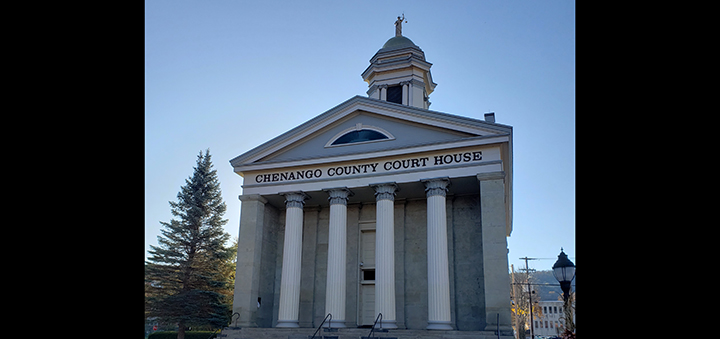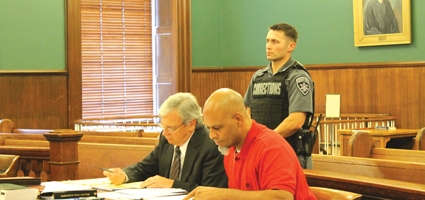
NORWICH – The jury case in Chenango County Court continues this week involving Jose Iran Gonzalez, 48, of New Berlin who was originally arrested in Oct. 1, 2014 by the Norwich Police Department.
It is alleged that at approximately 1:34 a.m. on Oct. 1 at the Howard Johnson's Hotel parking lot, located at 75 N. Broad St. in the City of Norwich, Gonzalez did knowingly and unlawfully possess 45 envelopes containing the narcotic drug heroin and 10 oblong white tablets marked “176” containing the narcotic drug dihydrocodeinone with acetaminophen, with the intent to sell.
This arrest stemmed from an alert, which was put out by the New Berlin Police Department for a stolen vehicle.
It is also alleged that when the vehicle was located in the Howard Johnson's parking lot that there was another individual inside the vehicle. Gonzalez was not in the vehicle when the car was approached but was found nearby.
Gonzalez, then 47, was charged with criminal possession of a controlled substance in the third degree, a class B felony; possession with intent to sell; criminal possession of a controlled substance in the seventh degree, a class A misdemeanor; and unauthorized use of a motor vehicle in the third degree, a class A misdemeanor.
Opening statements and witness testimonies were finally heard on Thursday Sept. 10, following a prolonged attempt to fill the 14-jury seats.
Following the opening statements and hearing the testimony of the first witness which was Norwich Police Officer Thomas Miller, fellow employee NPD Officer Ryan Legacy was called to the witness stand by the prosecution.
After swearing Legacy in to speak truthfully under oath, Thomas Bowen for the prosecution began by asking some basic questions involving his employment, before digging deeper into the night in question, Oct. 1, 2014.
Legacy gave his account of the night, which matched Miller’s account very closely.
Legacy noted, “When we placed him into custody, he was a little tense, only a bit of struggle.”
“Have you dealt with people who have been high before, how many times?” asked Bowen.
“Yes I have, probably hundreds of times,” answered Legacy.
“Did he appear to be high when you arrested him?” said Bowen.
“No he did not,” replied Legacy.
To which Bowen asked, “Are you familiar with heroin paraphernalia?
Legacy replied, “Yes I am, they usually have spoons or a syringe.”
“Did he appear high on heroin?” asked Bowen.
Legacy answered “No,” before being interrupted by Cameron who was voicing an objection for leading questions. The objection was sustained by Downey.
“I don’t know that much about it honestly, but I have dealt with people under the influence before. I did not notice any marks on him at the time of the arrest,” said Legacy further responding.
At this time Cameron was given the chance to cross-examine the witness to which he began by asking Legacy, “Were you present for the shift briefing that morning and was Gonzalez talked about?”
“That is correct, I was there and we discussed Gonzalez having the stolen car,” said Legacy.
Cameron then asked Legacy if he was familiar with how heroin could be ingested other than by injection. “Like snorting, smoking, or putting it in your mouth?”
To which Legacy responded, “They could I suppose.”
Legacy then confirmed that Officer Miller was the actual arresting officer and that he was simply observing, and therefore Miller was the one who processed the evidence.
A few more questions were asked regarding the size of the metal pipe as well as regarding the location Gonzalez was when he Legacy first approached him.
“It was about three to four inches approximately. When I came around from out front I first found Gonzalez in the lobby of Denny’s,” said Legacy.
At this time Legacy was dismissed and the third witness, James Lamphere, who works for the New York State Police crime lab, was called to the stand and sworn in.
District Attorney Joseph A. McBride was present at this time and asked to be the one who interviewed Lamphere for the prosecution.
Lamphere per request from McBride first explained the different tests that are done in the lab to a substance to determine what drug it actually is. Lamphere explained three separate tests that are done, telling how each test gets more and more specific as well as accurate.