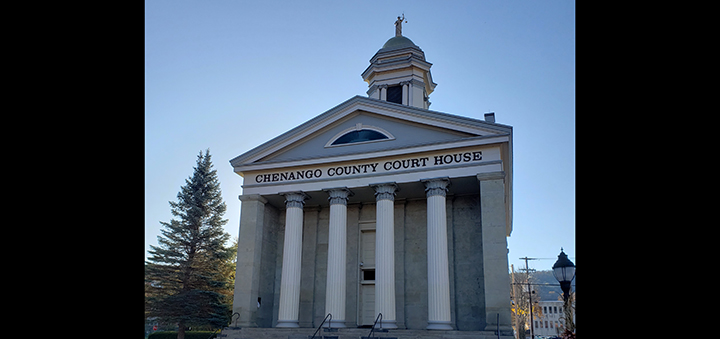
CHENANGO COUNTY – In an attempt to inform Chenango County residents on court proceedings and how tax dollars are spent, Chenango County Attorney Alan Gordon discussed the matter of conflict of interest and special prosecutors with The Evening Sun.
“As a general rule, an attorney cannot represent a client if there is a potential conflict with respect to a previous case,” said Gordon.
It was explained that if it’s presumed that an attorney has knowledge of confidential information regarding a case, it is an “ethical no-no” to prosecute said case.
“The general rule is that in a small office setting there is imputed knowledge,” said Gordon.
In essence, imputed knowledge is the presumption that what one person in a law firm knows, everyone in that law firm knows.
Gordon explained that this rule extends to district attorneys’ offices and public defenders’ offices alike.
“There are some times, though, that it is not a problem,” said Gordon. “There are some instances when you can hand a case off to an assistant within the office.”
Gordon said if that is not possible, a special prosecutor must be brought in by the judge.
“In Chenango County, there is almost always a conflict,” Gordon said. “In bigger counties, they can build in safeguards or firewalls to keep employees out of the loop.”
Gordon explained that the firewalls are not done in small offices such as in Chenango County, as it would be nearly impossible with an office staffed of three.
Gordon added that when he was a public defender in Chenango County, it was during a retrial Peter Wilasuik, the man accused of killing his wife in the Town of Guilford in 2002. “He (Wilasuik) had gotten a new trial, and we were prepared to defend. The defendant then raised the issue that at the time of his initial charge, James Cushman was an Assistant District Attorney. At the time of the retrial, Cushman was an Assistant Public Defender.”
Gordon said, “Even though he wasn’t involved in the retrial, he was on the staff.”