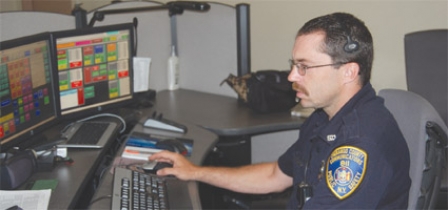
NORWICH – The Public Safety Answering Point, more often known as the 911 Call Center, is a part of the Chenango County Sheriff's Office and is a necessary, but often unrecognized part of emergency response.
“Emergencies always start and end at a local level. Every emergency starts and ends with the dispatch center,” said A. Wesley Jones, Chief Dispatcher for the CCSO. “Nobody does this for the thank you’s. We're heard and not seen.”
The public safety dispatchers are required to take all emergency calls to determine the issue and the location of the incident. They also have to dispatch the appropriate response team. This involves a great deal of multi-tasking, even more so than bigger 911 centers because CCSO dispatchers are required to do both, while bigger call centers assign the tasks of answering and dispatching to separate people.
Currently, the 911 Call Center has 10 full-time staff members and four part-time staff members. There is always at least two dispatchers on call during each shift, with more if it is a busy night or if a large emergency occurs. The 911 Call Center deals with approximately 40,000-45,000 events a year, and receives between 100,000-115,000 phone calls a year.
In order to be a dispatcher one must first pass a civil service exam, and if hired, one is required to go through extensive training and certification. The Emergency Medical Dispatch class is important because it trains dispatchers to give pre-arrival instructions to the person on the phone before the ambulance arrives.
“For instance, if someone has chest pain, the dispatcher can determine if they can be given aspirin,” Jones said when explaining pre-arrival instructions.
The dispatcher asks the person on the phone a series of questions that prompt instructions through a program on the computer, and that ensures that the patient or victim receives any possible care while waiting for the ambulance’s arrival.
All dispatchers are required to maintain certification and training after they are hired. Jones explained that CCSO's 911 Call Center is accredited by the New York State Sheriff's Association, and involves meeting or exceeding 75 different standards. Accreditation is voluntary, and CCSO's 911 Call Center is one of the few 911 call centers in New York state that has received it.
Most people will make a 911 call only a few times over the course of their lifetime, but those moments can be the most dangerous and frightening. These situations can range anywhere from dire physical conditions and fires, to domestic violence and car accidents.
“This is not a job for everyone. The fail out rate is quite high,” Jones said when describing how many make it through the training. “It's not so much being book smart. What hangs people up the most is they must have the ability to multi-task, which is more than most people do in everyday life.”
Beyond the high volume of calls and variety of tasks to be completed, Jones explained that the calls can take an emotional toll on the dispatcher. When asked about a call that was the most stressful, Jones described taking a call about a house fire in Pharsalia.











