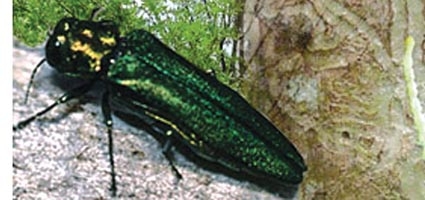
CHENANGO COUNTY - With the recent emergence of the Emerald Ash Borer in areas surrounding Chenango County, there is growing concern among local municipal leaders of how the problem should be addressed when it hits closer to home.
In response, the Chenango County Planning Department is working in collaboration with the Cornell Cooperative Extension of Chenango County to prepare residents, landowners, and municipalities in Chenango County for the inevitable damage wrought by Emerald Ash Borer (EAB), which planners say could cost towns and villages hundreds of thousands of dollars to clean up.
“We have concerns that it's getting close and concerns of the cost to municipalities when it does come to the county,” said Chenango County Planning and Development Director Donna Jones. “This is something local governments may have to think of as they do their budgets in the next few years, and it’s something we definitely want to be proactive in.”
EAB - an invasive insect that feeds on ash trees - was spotted in the nearby township of Unadilla earlier this year, and the likelihood that it will spread to surrounding regions gave reason for the New York State Department of Environmental Conservation to issue the quarantine of raw ash wood products, including firewood, south of the New York State Thruway. The DEC warns that each insect is capable of traveling 3-5 miles every year, notwithstanding the transport of ash wood.
According to environmentalists, the loss of ash trees would have an unavoidable impact comparable to the loss of American elm or American chestnut. In addition to shade and aesthetics, ash trees provide wood commonly used in manufacturing tool handles, bows, furniture, and baseball bats.
But it’s the cost of removing dead and dying ash trees that have local officials alarmed. Ken Smith, Director of the Cornell Cooperative Extension of Chenango County, said there is growing concern that the pest may become more a local issue within the next two years. “We are starting to get some phone calls already,” he said. “The problem we face is how we are going to deal with (EAB), either by trying to prevent it or by removing the trees that die as a result of it.”