Although recent flooding has caused considerable damage, some use the power of moving water to their advantage. Arrowhead collectors, also known as head hunters, tend to find large quantities of Native American artifacts after major flooding.
This is my twenty-third year hunting the rivers, streams, and fields of New York for Native American artifacts. As a child, I found my first arrowheads or points in the states of Virginia and North Carolina. I never knew how an old stone could cause so much excitement until finding my first hand-made tool. At the age of 13, I moved to New York and brought my passion for artifact hunting with me.
I, as many local artifact hunters, was fortunate to meet the father of amateur archeology in our area, Mr. Ted Whitney. My story plays out the same as most who were lucky enough to meet this irreplaceable piece of our local history.
I wandered into the Rexford Street Museum on a hot summer day in 1990. The reason being that it contained a substantial collection of native artifacts. I was invited in by Mr. Whitney, and found myself in the midst of a crash course in archeology. He explained how and where to look for artifacts, but left the exact locations as to where to find them out. He told me that native peoples’ lives revolved around water systems, and that artifacts would likely be found in close proximity to these areas.
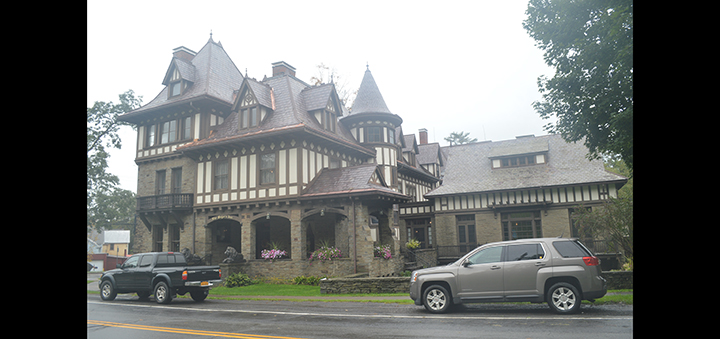
He then took a white-tailed deer antler and a piece of local chert, low quality flint, and proceeded to chip a crude point in minutes. I was hooked. I begun to save the chert flakes that I found, and through an immense amount of trial and error, I begun chipping points and knife blades of my own. He finished his tutorial by taking me next door to what was the big red house at the left of the museum. He let me throw some atlatl darts at a target, and filled me in on the weapons history.
The atlatl is a stick approximately 24 inches long with a hook or spur at the distal end. A long arrow, known as a dart, is placed onto the spur using a concave depression at the feather end of the shaft. Darts reaching up to seven feet were able to be thrown using the atlatl at high velocity in comparison to a hand-thrown spear.