By the last week of May, most turkey hunters have had all they can take, and hung up their calls until next spring. Turkey hunting is a struggle for the most part, and as the season draws to an end, things seem to add up to make it almost unbearable. Most find it hard to get birds late in the season, while some use the hens nesting habits to aid their efforts.
Finally, the hens have begun to set on their nests, gobblers beware. Hens will get up briefly a few times a day to water, feed or breed, but will immediately return to the nest to continue incubating their eggs. During this time period, the gobblers tend to wander less, and favor hanging around nesting hens still in need of their service. I find these lonely, late -season birds to be the easiest to harvest. Older gobblers four to five years of age tend to travel with large groups of hens making it quite a chore to get them during the early weeks of season. While the same bird may charge in, like a group of jakes when abandoned by his hens for the day. I recommend calling less and not as aggressively as most gobblers have heard enough human imitations to become call-shy by now.
I find the roost hunt to be less effective late in the season, probably because the hens have the gobblers occupied at first light. From my observations the hens tend to feed and breed and head back to the nest by eight a.m. This pattern favors what I call the lazy man’s hunt. Get up late, head out by eight. I then roam known nesting areas like thick brush lots, hedge rows and grown up abandoned fields. I try my best to approach a known set up location as stealthily as possible. I usually set up my decoys and call for up to an hour. If nothing is heard, I split and head to a new location. I've found if a turkey gobbles to you after nine am. for the rest of the season you will typically either see or shoot the bird. Since hens will set through a rain storm to protect their eggs, rainy days are actually good days to hunt in the spring.
As you get deeper into May, the comfortable temperatures begin to give way to hot and inclement turkey hunting weather. The black flies and mosquitoes are typically thick enough to just about carry you away. The heat will cause you to dress light, but the mosquitoes can bite you through the thin fabric,, so you need to use a repellant of some type. All forms of hunting require small tweaks in your routine to keep up with the changing season. The trick is to be able to judge when the routine is beginning to change, and capitalizing on it.
–––
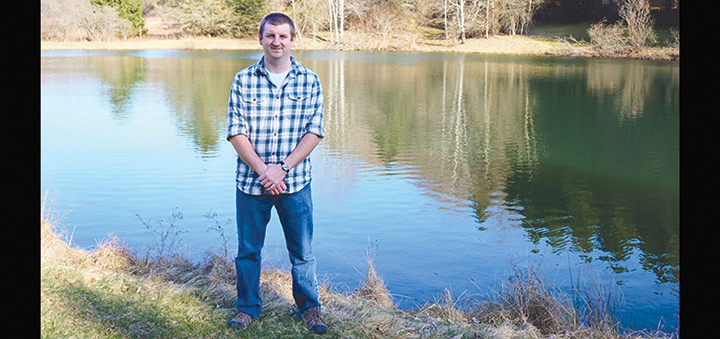
While afield on May 17, a full-on gobbling fool was finally encountered. Jared Meek and I had opted to fish starting at eight a.m., and planned to finish by noon. The fish were biting, but pretty slowly, when Jared snapped his head around and said, “did you hear that?” I asked, “What?” He replied, “I heard a gobble.” He said to listen in the direction of the hedge row bifurcating two large green fields. Almost immediately, we heard multiple gobbles, and I jokingly asked if he had his gun. He replied, yes, but neither of us were wearing the proper turkey hunting attire. Jared luckily had a camouflage sweatshirt on but was wearing a pair of military camouflage shorts. Even worse, I was wearing a checkered flannel and blue jeans. We decided to scrounge through our vehicles in an attempt to find enough camouflage to appropriately conceal ourselves. Jared had his turkey hunting vest, which most importantly contained calls, but also provided his gloves and face mask. I had no camo clothing, but unbelievably, I had a pop-up blind and a chair. All systems go, the hunt was on.