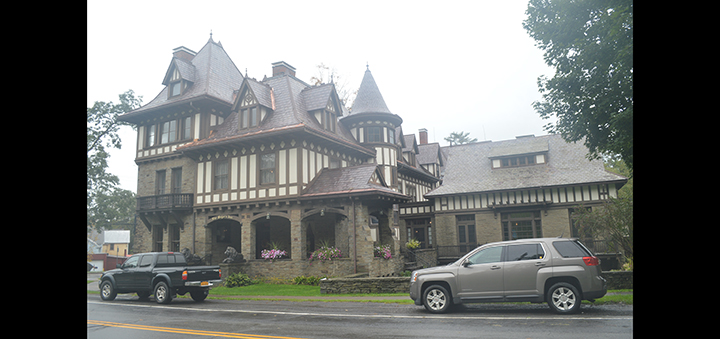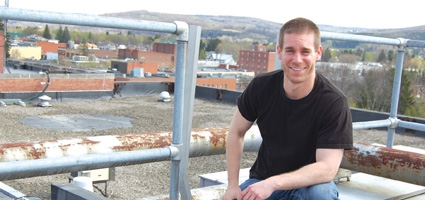
NORWICH – For this week’s edition of Punching the Clock, I sauntered over to the Eaton Center at 19 Eaton Avenue, enjoying the crisp spring morning air. I had opted to walk instead of driving, believing I would be consigned to the building’s interior for the duration of my stint at the center. I wasn’t quite right, however, but we’ll get to that.
Once on site, I met up with two of the 200,000 square foot building’s custodians, Matt Murphy and Jeff Steward. As luck would have it, the day I arrived was an important, transitional one for the Eaton Center, as the complex was switching over from its winter to its spring ventilation systems. Now, in most homes, this means adjusting a digital thermostat or – at most – dusting off window screens and throwing open doors recently soldered shut with frost. But in the Eaton Center, quite possibly the largest building in the city, making the transition from heating to cooling system is quite a bit more labor intensive.
Murphy and Steward showed me the building’s ventilation system, a massive network of ducts and iron works on the top floor, directly underneath a cooling tower located on the roof and the size of a short bus. The complex ventilation system creates a continues flow of fresh air in the Eaton Center, drawing in air from outside the building while mixing in air pumped-in from the interior. The temperature in different portions of the building can be controlled by the amount of air being sucked in from outside of the building. As the sun moves across the horizon each day, certain portions of the complex need to be heated or cooled, depending on where the sun is hitting it. Thanks to modern technology, the building’s custodians can regulate the temperatures of different sections of the building utilizing their smart phone. Before in the instillation of the new software, the first two hours of Murphy’s mornings consisted of him running to every gauge in the building and recording the meters. Now he can just sit down at a computer, all of the data just a finger click away.
During the county’s warm season, the heating/cooling component of the ventilation system has to be changed out. The 800 or so pound cooling system is made up of a series of coils which are pumped full of cooled water. Once installed into the system, air is jetted across the cold coils by a propeller on the roof that looks like it was stolen from a circa 1940s Boeing B-17E “Flying Fortress” bomber. The rushing air passes through the tightly interlocking network of coils, cooling it to the desired temperature, circulating 20 to 25 percent fresh air at all times.
In order to install the nearly half-ton cooling coils, they must be hoisted off of the ground about five feet and fastened to the ventilation system. To do this, our trio each grabbed a corner … No that’s a lie, instead we grabbed a chain and pulley, hooking it onto the top of the coils, raising it into the air using what Murphy called a “mechanical advantage.”