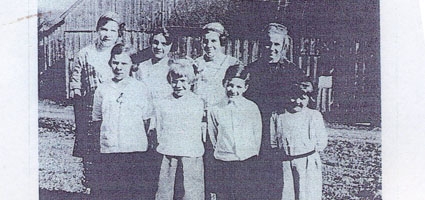
This week we return gain to the southwestern section of the township of New Berlin for another chapter in this long running series, which in passing in #199, for a written documentation of “The One Room School” written by Mrs. Anna Grover Camp for The Yorker Club of South New Berlin Central School in May of 1965. However before this writer quotes verbatim what Mrs. Camp wrote the photo which accompanies this article we are fortunate that the students are identified, which this writer has been advised is popular with all that read these words of educational history. These few students are identified as follows: Back Row (from left) Mildred Almsted, teacher Mrs. Ada Follett (deceased) Gladys Almsted and Esther Johnson (later to become Mrs. Bertil Olson) Front Row: Arlene Utter, Doris Almsted, Ken Utter and Viola Sickler. One cannot help but wonder if Ken Utter was somewhat “picked” on by those six females!
Now for the story!
“The small, one room school, which played such an important part in the lives of the early settlers, is fast becoming a part of our American history. As a pupil and later as a teacher in one of these small schools, I would like to give the Yorkers some of the most interesting facts as I remember them.
“In the spring of eighteen hundred ninety-six, my father moved his family from Afton to a home near Hunt’s Lake. At that time, a branch of the Ontario and Western railroad ran from Sidney to Edmeston. We came by train, and it stopped at the flag station at the foot of Buttermilk Falls to let us off. (Note: this would be at what was known as New Berlin Center on the railroad.) On the way to our new home we passed a small white building which my father said was the schoolhouse where we would go to school. I had been to the Afton High School for a few months, and when I compared this small building with the large one, it left an impression on my mind that I will always carry with me.
“When the country schools districts were first formed, they were made small enough so that by building the school house as near the center as possible, the child living the farthest away would not have to walk more than two or two and one half miles to walk to and from school.
“When a site was needed on which this particular school could be built, a small portion of land was taken from the meadow just north of the home of Israel Angell. The school district has always been called the Angell District. (Note: this writer stands corrected for the incorrect naming of the district as Hunt’s Pond and I had better prepare my research more thoroughly.) The building faced the east and on the northeast corner was a small woodshed and the flag pole.
“There were no windows in the front - only a heavy door. When you passed through this door, you found yourself in a narrow, dark hall with two doors leading into the main room. Between these two doors, nails had been driven into the heavy plank wall. Here the children hung their coats and hats. The boots, rubbers, and tin dinner pails were put on the floor underneath.
“On the outside wall to the left of the door was a long shelf. On this was a tin water pail with a small tin dipper. There was also a wash basin, a cake of soap, and a towel hanging near. The children all hurried in from play to see who would be the first to drink from the dipper. The water was brought by the older boys from the Angell home.
“Going from this dark hall into the main room, you found it to be clean, light and pleasant. The walls were wainscoted. Above this, they were plastered and papered. The ceiling was a clean white wash. There were two windows in each of the three outside walls. The east wall between the two doors was covered by the blackboards. There were two rows of long wooden benches with a desk. Three or four children could sit in each seat. They were painted a light gray like the rest of the woodwork.
“In the center front stood a large, wood-burning stove! The stovepipe went up and across the room to the back where it went into the chimney. On wet, cold days the mittens, caps, and rubbers were put on the floor around the stove to dry. The extra wood needed for the day was brought in by the boys and placed in the hall.
“In the southwest corner was the teacher’s desk and chair. Under the window near the desk was a shelf. On this shelf was a dictionary, a globe, a box of chalk, and a few books belonging to the teacher.
“In the northeast corner were two large charts. One was maps and the other was material used to teach the beginners. There were no lamps, so that when a meeting was held at night, the men brought their own lanterns.
“The boys and girls share the playground with their games and were not supervised unless trouble developed. They had all the physical exercise they needed with their games and the walk to and from school. The school Christmas tree and the picnic at the close of school in June were the two most important events for parents as well as the children. During the winter months, the older farm boys would often come to school. Some came to see how much they could learn, and others came because there was nothing better to do.
“Our day began each morning with a reading from the Bible, the saying of the Lord’s Prayer and the singing of one or more songs. Some of the teachers had been musical enough to teach the children some of the old familiar songs. One of the favorite ones was called ‘Swinging ‘Neath the Old Apple Tree.’ To you who have had the best of musical training, this would have sounded very off key, but we were good and loved this part of the day.
“The most emphasis was put on the teaching of reading, spelling, writing, and arithmetic to the small children. Geography began in the third grade and history was added in the seventh and eighth grade. With their English lessons, the pupils were kept busy. A few years later, physiology and nature were added to the list.