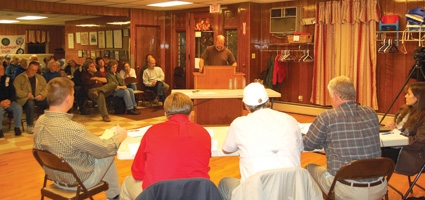
OXFORD – Around 120 concerned citizens, both for and against the enactment of a nine-month moratorium on hydraulic fracturing, poured into Oxford’s American Legion Tuesday night for a public hearing hosted by the village board.
Citizens were given the opportunity to voice concerns regarding the village’s fracking measure. The proposed ordinance was recently reviewed by the Chenango County Planning Board, which approved it with concerns. Before opening the floor to the public, Village Mayor Terry Stark addressed the county’s concerns and stated he fully intends to respond to them within the next five to six days.
It was also announced that, due to the absence of board member Dale Leach, the board would not make a decision last night. Instead, Stark said the village would make use of the 60-day grace period after the public hearing to make its final decision. The meeting was taped for Leach to review and Stark said he’d make the board’s decision process as transparent as possible, making every effort to inform the public when the final vote will be on the agenda, with the earliest possible date being the board’s next meeting on Nov. 27.
Thirteen people addressed the board last night – five spoke in opposition and eight spoke in support of the moratorium.
Bryant LaTourette of Oxford addressed the board with questions concerning the village’s lawyers. “From my understanding the moratorium was drafted by the Slottjes for free, but who really paid for it? They are responsible for the moratorium stricken down in Binghamton ... Before you make your final decision, I ask you to wait for New York State regulations to be released. At such time, then study them to avoid any unnecessary waste of time and your taxpayers’ money. After your proper due diligence, then structure a moratorium allowing for time and funds to be properly allocated.”
Willard Bradley of Oxford spoke next. “I have questions pertaining to the county board’s concerns. It appeared to me that the county would actually be in charge of the Oxford zoning, but it sounds like that is actually not going to be the case and there was just a disagreement of terms, is that correct?”
Stark responded that was the case. The county referred to enforcement officers as opposed to Oxford’s zoning officer.
Bradley’s second point involved the county planning board’s concern over the difference between the Binghamton moratorium and the one proposed by the village.
Stark said the difference involved the fact that Binghamton invoked its police powers to initiate that moratorium, which led to the court striking it down because it wasn’t justified based on the three-prong stipulation including the necessity of dire emergency, whereas the village of Oxford’s proposed moratorium derives its legitimacy from land use, or zoning ordinances, in which the stipulations regarding the police powers moratorium do not apply.