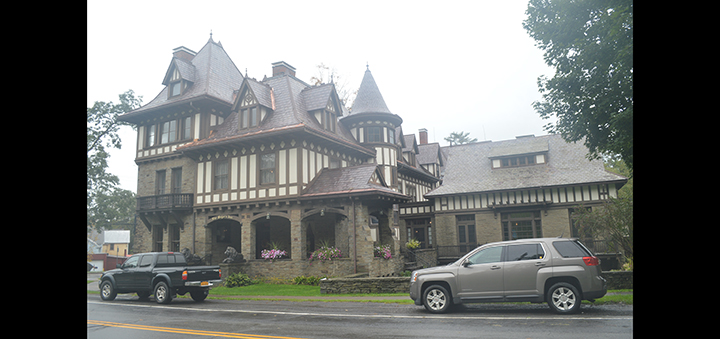
The district school house route this week takes us to County Road #7 and just above the Beckwith Road for a glimpse of the district so named above. The photograph with this article was in 1976 and documented as being Great Lot #28 in the township. For this article it will be quoted verbatim as was researched first by the late Elinor Troicke - historian and for the documentation researched by Mrs. Jennie Preston. Without this information these articles would not be possible. Additionally credit must be given to Donna Robb for allowing this information to be copied for this series on McDonough’s district schools. As a note of interest, this writer was asked the other evening, how many district schools in Chenango County and when it was related 315, to say they were surprised is a mild statement.
Mrs. Troicke noted on the photograph the following information: ‘“The Haydens and Beckwith’ are family names often associated with School District #8. The photo was the second schoolhouse on this site (the first was built around 1840) and was voted on successfully at a special school meeting on December 21,18569. It had dimensions slightly expanded to 26 x 20 feet. Now it stands empty, though it has been refurbished into family living quarters for some time.”
Mrs. Preston’s research is as follows; “The information obtained about this schoolhouse was taken from a ledger containing the minutes of the district’s annual school meeting. This ledger is presently the property of the McDonough Town Historian, Mr. William Hayden III (1970’s). Schooling done under this district as a whole began in 1839. In each annual meeting, trustees, a collector, a moderator, and a librarian were voted on. The cost of schooling for each school was one-half cord of wood (this has appeared numerous times in this series). $27.28 was given by the School Commissioners for the teacher’s salary and $3.96 was allocated for the library monies at the first meeting. On April 6, 1840, it was resolved by those present to build a schoolhouse with the dimensions of 18 feet by 24 feet. Specifications were made as to the exact location of the school, the locations of the seats, how many lighted windows there were to be, where the stove would stand, and how the floors were to be laid. The school was originally located on the property of Liman Beckwith (a family still found in McDonough.) In 1839 the money to build the schoolhouse was raised on the inhabitants’ taxable property; it came to the grand total of $100 to pay for the structure. The workers who built the structure were paid five shillings per day, though they had to board themselves. (A very curious thing to note is the mixed monetary units of dollars and shillings often expressed together. British influence still had a profound impact on the settlers of the McDonough wilderness. It was later resolved on October 26, 1840, that taxes overall should be raised to $106 so that a chair (presumably for the teacher), shovel, basin for the stove and a cup to drink in could be purchased for the school. The following year, things began getting organized and it was resolved to have three months of schooling that winter. Life apparently became less hectic and on October 3, 1842, they agreed to continue the three months of schooling plus using the school in the evenings for religious meetings. People in this area had their physical needs satisfied and now they needed to satiate their mental needs.
The following pieces of information are excerpts from the already mentioned ledger in chronological order.
“October 2, 1843 - it was decided to have female teacher through the fall and winter for four months and possible five. (This was different because people normally believed that on a man teacher could handle the “big boys.”) The cost of education was yet one-half cord of wood per scholar, but if each payment was neglected, a specially appointed person would get the wood and be reimbursed $1 per cord, “In 1842, it was received of the Commissioners of the Common Schools, the following sums; Rec’d of school money $27.05. Received from library money $4.82. Paid John Gibson $10, paid Diana Morley $16, paid for book $4.82.
“Resolved on October 7, 1844, that there be three months of winter school and three months of summer school. A desk was also furnished in the schoolroom (perhaps to go with the chair for the teacher.)
“A suitable case for the library was resolved to buy on October 6, 1845. Two books of Arabian Knights were to be sold also. A woman teacher was voted on for the winter months.
“A window at the school’s entry was decided to be taken out on October 5,1 846. A tax of $4.06 cts. was needed for building repairs, while another tax of 3 shillings was needed to replace the books sold at auction.
“October 4, 1847, a man teacher was voted on for the coming winter. Each scholar had to pay one-third cord of wood which was prepared for the stove in advance. The wood was to be measured by the teacher.
“A special meeting was ordered on September 9, 1848, and dealt with repairs and additions to the school. A tax of $28 was raised.
“The amount of wood per scholar was dropped to one-fourth cord of wood on October 4, 1848. The schoolhouse was thereafter not to be used for any other purpose except for the school.
“A special meeting on January 23, 1850 was ordered. There was to be three months of summer school with a woman teacher at $1 per week and three months of winter school which paid $13 per month. It was still at the cost of one-fourth cord of wood. (Note of interest - how tuition has changed!)
“The method of obtaining the scholar’s cord of wood was changed on October 7, 1850. Fifteen cords of hard wood were to be corded and fitted for the stove by any individual who could get it cheapest. At tax of $6.50 was made to pay Lorenso Bowdish for getting the wood. Minor repairs too were to be made on the schoolhouse.
“A new chimney and shingling around it was needed and resolved upon on November 17, 1851.
“Schooling was extended to four months of winter school and four months of summer. One-fourth cord of wood was to be paid by each scholar (as resolved earlier on October 6.) Each man was to be at the schoolhouse at two o’clock to attend to the measuring of the corded wood. If wood wasn’t paid, six shillings were required in payment.
“An addition to the schoolhouse was voted upon in a special meeting on September 26, 1853. The addition was to be the woodshed having the same width as the schoolhouse and twelve feet long on the east end of the schoolhouse.