This writer has been most fortunate to receive a copy of “Elbert Hubbard’s Scrapbook” which was published in 1923 and is a vast collection of assorted articles and phrases that upon occasion Mr. Hubbard sought to use. As a publisher you will understand his need for information! Additionally Mr. Hubbard and wife were aboard the “Titanic” when it went down and his son had the collection published in a book form. Not to dwell on Elbert Hubbard, one of the phrases in this marvelous publication was a quotation by Margaret Fuller-1810-50 (she would be classified in this modern age as the first woman activist for woman’s rights. Her quotation is “If you have knowledge, let others light their candles at it.”
Relevant to the education of all young students, whether it is from the one-room districts school or the modern sprawling schools of the twenty-first century. With this in mind it will give all thought, that if they themselves, be it teachers, lawyers, doctors, all professional persons, that the knowledge they teach and have access to be passed on through the generations to maintain our precious heritage.
This writer, will at this time, acknowledge the information credit of this district school to Marian Poole and to the former historian. Joy Barber, for sharing it with me for these articles relevant to the Lincklaen schools. Mrs. Poole wrote in her documentation of “Early Days in Lincklaen” that the school she knew best of was the Pond School, as four generations of her family had attended. The first school house in this district was a log cabin in what (at the time she wrote) in Art Brown’s pasture on the east side of the road near the top of the knoll. This cabin would be used till about 1885. Her father she wrote began school there at the age of five, being born in 1879. His recollections were of sitting on a bench at the front of the room without a desk.
He was happy if someone was absent as the he could use their seat. As has been documented time and time again, these long benches in the front of the schoolrooms were “the recitation benches.” Scholars of one grade would come and sit and the teacher would hear their lessons and instruct them in new work, all the while keeping watch of the balance of the students at their desks who were supposed to be studying.
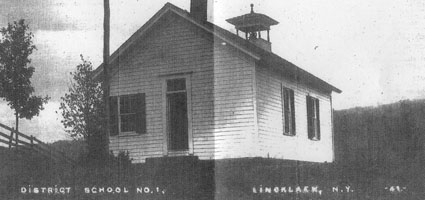
Later another school building erected on the knoll north of the old log cabin and was located among the trees on the same side of the road. There are large maples still standing, they being planted in 1890 by Alpheus Hendge, Charles Darling, Asa Swan and Orlando Poole. The new schoolhouse was a neat white building, as was the custom of that time, and had a belfry and bell on the peak of the roof. It was an honor to be allowed to pull the rope and ring that bell, calling students, “it’s time for lessons.”