This week and for the next several articles will be focused to the history that surrounds the schools that were and still exist in the Village of Guilford. With the settlement of what is now the village, the early pioneers, as has been written numerous times before, knew that their children needed to be educated. Previously written was the article relevant to the Ives Settlement School which was indeed primitive to say the least. In the village proper the first actual schoolhouse was just as primitive as it was a log cabin structure and you can only contemplate the fear that the children experienced attending this early educational institution, no real roads, the prevalence of wild life, bear, deer, bob cats, wolves, foxes, etc.
The first log cabin as has been written was built in 1810 - small, log cabin type building containing rough log benches and wooden desks.
This structure would not have a long life and by the year 1814 a “real” schoolhouse was erected for the huge price of $150.00 at the beginning of the Gospel Hill Road quite near the old underpass that was once the 0 & W railroad crossing. The unique site of the Hamlet, with the Guilford Lake (formerly known as Cable Pond -so named for the Cable family) and a rushing stream feeding off it, Guilford (or Fayette) was an ideal place for a settlement. The now “Guilford Creek” was a supply of both water and power and clean drinking water. With the arrival of many land-hungry people from the overpopulated east (New England) resulted in the town’s expansion. Many of the early settlers were veterans from the Revolutionary and War of 1812 who were given land grants in this area. More fortunate took their “bones” money and purchased acreage. With this settlement many pioneers brought with them the skills and expertise needed to this little community and started their businesses there.
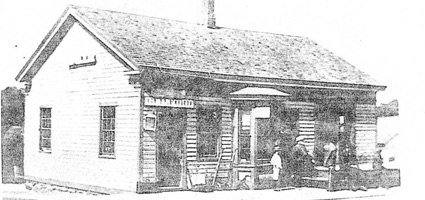
With the population explosion, it was time to think about a better larger school. Quickly the little Log Cabin Schoolhouse became antiquated. The residents made the decision to build a new school. By 1814, a clapboard and shingle building replaced the log cabin. With this new “modern “school building it has window frames, real glass, stove in the center. But the most important aspect was it was larger and could accommodate more students. This new building was completed in time for the school year and some years later the rough, wood desks and benches were replaced with more modern desks and seats.