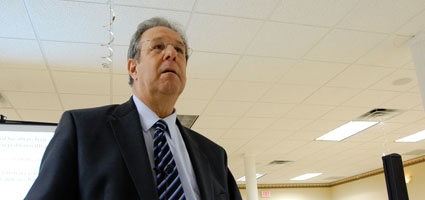
NORWICH – The Chenango County School Boards Association met Thursday for its annual fall dinner, which featured a presentation by Dr. Rick Timbs of the East Syracuse Statewide School Finance Consortium.
Unadilla Valley Board of Education member Sandy Cooper introduced Timbs, the retired district superintendent of the Erie 2 – Chautauqua-Cattaraugus BOCES in western New York, which is comprised of 27 school districts serving approximately 45,000 students. As such, Timbs has served as a representative of the Commissioner of Education and “was often asked to address educational, institutional and financial issues in school districts statewide,” said Cooper.
Timbs’ two-hour presentation included detailed information on inequities in the state’s educational aid formula and cuts over the past two years that have severely impacted low and average wealth school districts across the state. The distribution of state aid, according to the former superintendent, athletic director, principal, educator and union president, could be altered in such a way that it would be much less harmful to those districts.
Said Timbs, “This could be changed if someone would just do it.”
Low and average wealth districts have been forced – due to cuts in state aid – to drastically reduce staff and dip into their fund balance, stated Timbs, and districts such as those that comprise the DCMO BOCES region are “running out of both.” If these conditions continue, he added, the quality of education offered will suffer.
“These districts have been severely disadvantaged,” said Timbs. “You’re getting the short end of the stick, I think ... there’s no excuse for this continued inequity.”
There are three questions, he added, that state government must address: where is the mandate relief? Where is the equitable funding distribution? And where is the sound basic education?
“The truth is, all kids should be treated fairly, no matter where they live,” stated Timbs. “In his budget presentation for the 2011-2012 school year, Governor Cuomo said we must ‘ensure adequate funding to high-need districts which historically have not been adequately funded.’ This is what we call rhetoric.”