Editor’s Note: This is the first in a three-part series describing a tour of Chenango County agriculture that was offered up this month to New York State’s elected officials. The bus stops highlighted the county’s unique ag businesses, but also pointed to the governmental regulations that challenge them.
NORWICH – Chenango County pitched over much more than a bail of hay last week to New York State officials who visited a sampling of the types of enterprises that make up the local agricultural industry.
Using a three-pronged approach, the tour showcased the cutting-edge conservation practices in place on the Tumilowicz Dairy farm, highlighted the new demand for milk from Chobani yogurt’s parent, Agro Farma Inc. and displayed the innovate organic vegetable and fruit growing systems under cover at Norwich Meadows Farms.
A bevy of agencies hosted the event, including Cornell Cooperative Extension, Chenango County Farm Bureau, Commerce Chenango, the Chenango County Planning and Development Department and Chenango County Soil and Water Conservation District. Numerous county supervisors made up the 34 in attendance. State officials on hand were: New York State Assembly members Donna Lupardo (D-126th Dist.) and Peter Lopez (R-127th Dist.) and staff representatives from the offices of Assemblyman William Magee and Senators James Seward (R-51st Dist.) and Thomas Libous (R-52nd Dist.)
Tumilowicz Dairy
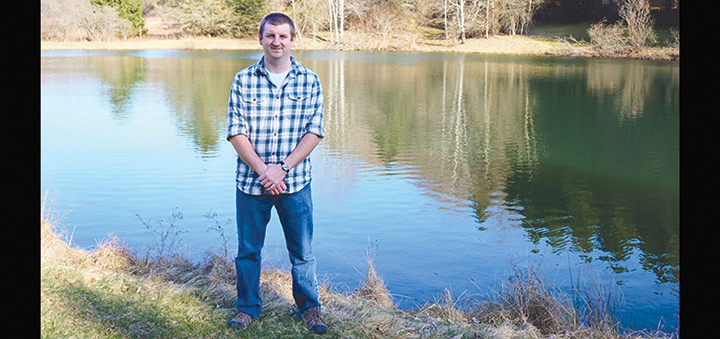
The 200-acres plus Tumilowicz Dairy, now going on its third generation in Norwich, is one of 213 dairies in Chenango County. And like most, with rising input costs for everything from fuel to feed flying in the face of stagnant milk prices, farmers Bob Tumilowicz and his son, Alex, have used available state and federal financial assistance programs to manage the pressure.
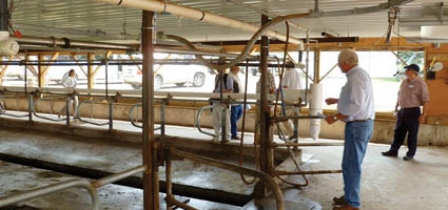
Over the past decade, the Tumilowiczes have expanded their barn in order to increase the milking herd to 80 cows; poured a concrete, ribbed and sloped barnyard surface that stores manure and keeps rainwater separate; dug a new well and piped fresh water to 10 water troughs; erected high tensile fencing; and built riparian buffers and paddock crossings that keep cattle out of streams, ponds and any standing water.
Total investment? Upwards of $100,000. It took lots of soul-searching and patience, according to the father-son team, but the enhancements are already paying off.
“The improvements work both ways for the people and for the farmer. Water quality is important for us all. My cows are spoiled. I didn’t want to dig it, but they do like that well water better,” said Bob, “and they are healthier.”
Spending $60,000 on the barnyard alone was “a huge investment,” according to Alex.
“The barnyard is one of the greatest investments for a farmer. We used to loose some regularly, from slipping and twisting their ankles in the barnyard. I’d have to get in there and take them out. We aren’t loosing good cows anymore,” he said.
Multiple players within Chenango County Cornell Cooperative and the Farm Service Agency guided the Tumilowiczes through the bureaucracy of applying for federal Conservation Reserve Program and state Agricultural Non Point Source Pollution and Abatement funds. Combining programs to maximize the benefit takes reams of paperwork and layers of approvals, but it ultimately lessens the amount of matching funds from a farmer’s pocket.
Soil and Water Director Lance Lockwood said he couldn’t stress enough that good water quality and a healthy herd results in a more profitable farm.
“It rained on this farm yesterday and I want to tell you that the water that left here was a lot cleaner than it was 10 years ago,” said Lockwood. “And as for the economic benefit, Bob is leaving in his son, Alex’s hands a much better quality farm.”
David Balbian, dairy management specialist with Cornell Cooperative Extension, pointed out that three-quarters of a dairy’s cost goes for feed. To get the biggest bang for their buck, he described how the Tumilowicz’ precision feed management system results in more protein actually leaving the farm in tanker trucks of milk than what’s being consumed by the cows in grains.
“The aim is to minimize the environmental impact of how we feed our cows, and the two biggest worries on any farm: how much nitrogen and how much phosphorous remains,” he said. “They are doing an excellent job at that.”