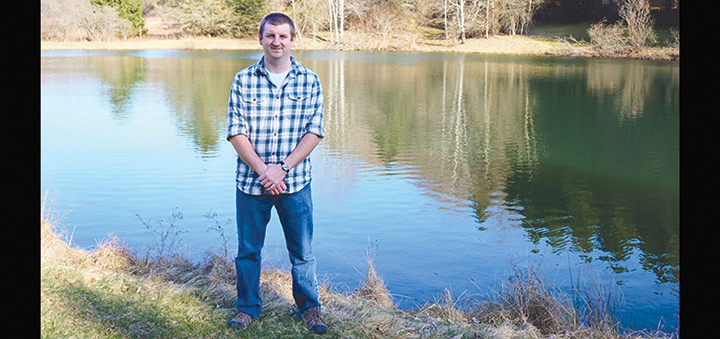
NORWICH – As members of the Chenango Chapter of the New York State Archaeological Association, Josh Sheldon and Dan Noble have spent countless hours studying the lives, cultures and history of New York’s Native American population.
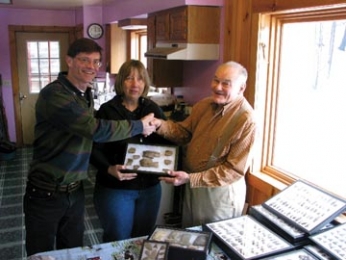
This spring, Noble and his family gifted a priceless collection of approximately 1,000 Native American artifacts to the New York State Museum in Albany. The artifacts were gathered over the course of over six decades by George W. Noble – now of Reno, Nevada – his parents Daniel and Pearl Noble, and his brothers Dan, Charles and Bill. According to Noble, the boys were mentored in archeological techniques by their high school teacher, Stanford Gibson, still widely respected in the field. For half a century, Noble has maintained the integrity of the collection, in a number of cigar boxes locked away in an antique carpenter’s chest. Sheldon began working with Noble over two years ago, assisting him in cataloging the artifacts and arranging them so they could be safely displayed.
The collection doubles the amount of cultural materials held by the State Museum from the “White site,” located three miles east of the city, Noble reported. In addition, it gives the museum its only collection of artifacts excavated from the “Airport site,” a multi-component site one mile north of Norwich. That collection is one of only two not thrown away to heirs or auctioned away, added Noble.
Sheldon has been searching for – and collecting – Native American artifacts for years now. According to Noble, he’s extremely adept at finding sites of native occupation. In fact, one site, named after Sheldon, was in an area that professional archaeologists had unsuccessfully explored to a depth of two meters with a backhoe. The site proved to be the seasonal camp of the occupants of the White site, said Noble, which local archaeologists had sought for decades.
The digs Sheldon has been involved with begin with a consultation with professional archeologist David Moyer. Sites that are large – or whose occupants are unknown – begin by breaking down the area into ten meter squares and documenting that information on what’s called a site map, said Sheldon. Small test pits are dug to determine an actual site’s location and – upon discovery – the site is broken down into one meter square sections. He then records the opening depth, documents any surface findings and proceeds to slowly dig with a hand trowel, documenting findings using vertical and horizontal measurements.
“In a properly documented dig, you could put objects precisely back where they were found,” said Sheldon.