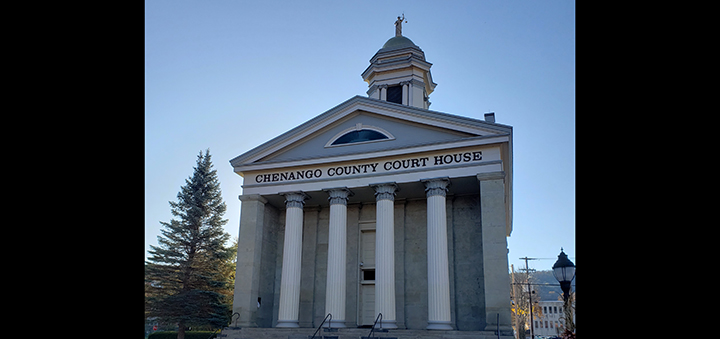
GREENE – The New York Supreme Court’s Appellate Division reversed a decision by the Chenango County Court this week after it determined a warrant used to seize child pornography was incorrectly filled out.
The defendant, John M. Gavazzi, 47, Greene, was arrested June 25, 2009 following an investigation by New York State Police into child pornography Internet trafficking. During their investigation, police executed a search warrant at Gavazzi’s residence and allegedly seized electronic and printed images of child pornography that were also being transferred over the Internet.
On May 3, 2010, State Police Investigator James Szenher admitted in a suppression hearing before Judge W. Howard Sullivan to making an error on the warrant. At the time, Public Defender Alan Gordon argued to have it thrown out, along with all the seized evidence.
Gordon pointed out the warrant was incorrectly labeled “Town of Broome Court, County of Broome,” when identifying which court approved the warrant. The warrant’s correct label should have been “Town of Greene, County of Chenango.”
“We have a warrant based on a court with no jurisdiction, your honor. Nowhere in the document does it again mention the issuing court. From what I understand, this is a critical error. Further, your honor, anyone served with the warrant wouldn’t know it originated from the Town of Greene Court; just looking at it one should realize there is no Town of Broome Court anywhere. Certainly it’s our position that the officers or any other person bothering to read the document over before serving it should have picked this up,” said Gordon at the hearing.
However Sullivan ruled against the defense and the case was scheduled to proceed to trial with the evidence against Gavazzi intact.
Szenher told the court he accidentally clicked on the wrong town when creating the warrant on his computer. The mislabeled document was later presented to Village of Greene Justice Michael Dietrich. Dietrich signed the document, which also did not include a printed version of judge’s name on the form. Gordon displayed the warrant in court comparing the signature to a doctor’s note, saying it was illegible.
This week, the Appellate Division agreed with Gordon’s arguments and the five judges unanimously set aside Gavazzi’s sentence and any evidence seized through the warrant is now inadmissible.
“All the material evidence in the case was obtained by the search warrant. The evidence is gone, so there’s really no case,” said Gordon.