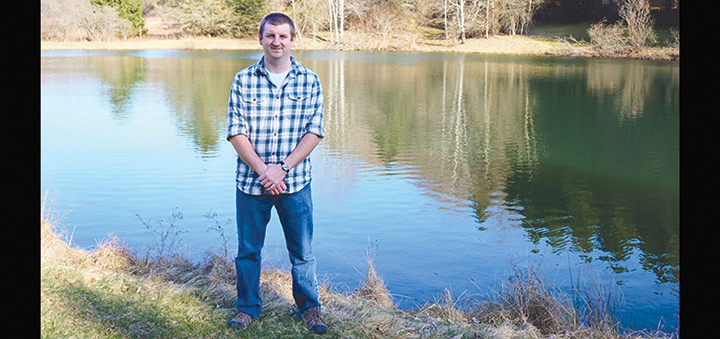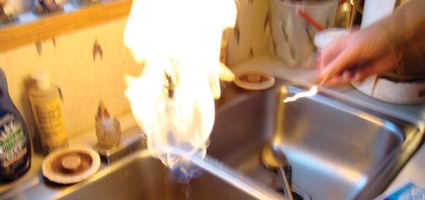
GUILFORD – Guilford Center resident Robert Sandell keeps a blow torch near his sink and regularly ignites the methane-induced water coming out of his kitchen faucet for fun.
Sandell described his hobby and displayed photos and videos as proof to a group of reporters in The Evening Sun’s offices last week.
“If it was going to kill me, it would have by now,” the 74-year old said, explaining that he drinks about 10 cups of coffee a day using water from his tap.
Sandell’s story may sound familiar, particularly to those following the controversial hydraulic fracturing process that is being employed around the country to release natural gas from shale formations. Fracking, as its called, is the subject of Gasland, a documentary film nominated for an Oscar at the Academy Awards presentation on Sunday. One of the film’s premises is that the technology, which requires millions of gallons of water mixed with soap, sand and a number of potentially toxic chemicals, is polluting the water table.
The closest natural gas drilling that has taken place near Guilford Center is more than 25 miles away in Coventry, according to the Chenango County Planning Department. Sandell, himself, pointed out that no drilling could have caused the methane in his water.
“I don’t think you can pollute any worse than what we’ve got going on,” he said.
When he decided to buy land and move his doublewide to Guilford Center 10 years ago, the former construction worker said his neighbors cautioned him about the “oasis of gas” underground. They even told him not to smoke in the shower.
“I said, ‘What are you talking about?’” he joked.
Methane abounds 300 feet under the ground in the region located less than 11 miles south of the county’s seat in Norwich. Sandell originally drilled his well 250 feet deep, but eventually moved it up 150 because the water was clearer. He said the drilling company was surprised to still find methane at the shallower depth.
Colgate University Geology Professor Bruce Selleck said the phenomenon is quite common, and not surprising at all for the Guilford Center area. He said the source of the gas is likely the Geneseo Shale underlying the 100-200 feet thick Oneonta Formation. The gas travels up from the Geneseo along natural fractures, and enters the well along with groundwater.