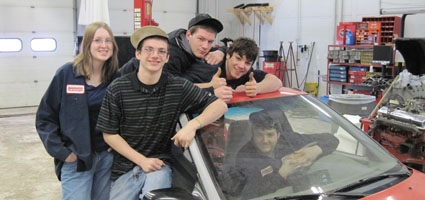
NORWICH – For the past two years, students in DCMO BOCES’ Automotive Technology program have been collaborating with their program and academic instructors, as well as with industry resources on an electric vehicle project. The venture had its birth in the summer of 2008 when auto technology instructor Pete Benson encountered the Cornell University X-Prize mule car at the state fair. When school started that fall, a team of students rallied around the idea of developing their own hybrid vehicle project. With hybrid and electric vehicle technology being pursued by a growing number of automotive companies, the project offered great student exposure to emerging technology.
The student team began their exploration doing research into the history, current state, and future of the electric and hybrid vehicle industry. There was a sharp learning curve getting familiarized with technology components and concepts relating to choice and integration of electric motors, batteries, and control systems. To aid in this quest for knowledge and give the students an Ivy League experience, several students joined instructors for a visit to Cornell University to meet with the X-Prize team, see their hybrid mule car, and glean from their engineering experience.
With a foundation of research under their belt, the team went through a decision analysis process and selected an electric vehicle conversion as the project platform, optimizing project complexity, cost, and time required. Students participated in selecting an industry source for component purchase and technical consultation, and delivered letters to local salvage yards, resulting in the donation of a 1992 Geo Metro. The focus of the project now turned to the hands on task of removing the combustion engine, and coolant, exhaust and fuel systems, in preparation for electric motor installation. A custom adaptor plate and coupler were incorporated to mate the electric motor to the transmission, and mechanical design and fabrication were required to modify transmission and motor mounts. On the electrical side of the project students learned to interpret a wiring schematic in order to build a control panel housing the high and low voltage components and wiring. A battery box was also designed and fabricated with help from auto collision students.











