NORWICH – The number of questions raised about natural gas gathering lines during a meeting of regional government officials in Norwich last week surprised an invited speaker from the New York State Public Service Commission.
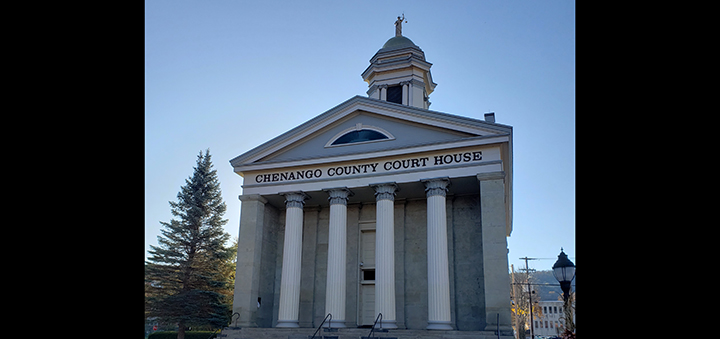
PSC Deputy Director James Austin said he “had no idea there were this many concerns out there” regarding the smallest of buried pipelines. Austin spoke before the Chenango, Otsego, Delaware, Madison Regional Natural Gas Collaborative at the Chenango County Office Building Jan. 20.
New York State holds issues of environmental safety “very high” compared to other states, he said, before outlining a tiered system of gas line construction regulations that are meant to control and minimize soil, water and air impacts.
But the law, described within the PSC’s Article 7, requires oversight only on natural gas pipelines that are more than 124 Pounds per Square Inch of pressure and longer than 1,000 feet. The estimated 50 miles of infrastructure buried between wells in the towns of Smyrna, Preston and Plymouth, and future line planned for construction this summer in Coventry, are, for the most part, exempt from the agency’s oversight, he confirmed.
The group’s meetings are held monthly to arm government officials with the information they need to keep abreast of the natural gas exploration and production, either planned or already underway in the region. Norse Energy, Inc., Gastem, Inc. and other companies are actively leasing land in the four-county area for wells and pipeline easements, and testing, drilling, and even producing natural gas in some places.
Norse Energy, the company most active in Chenango County, is currently awaiting PSC review for a longer, higher pressure pipeline it plans to build to connect gathering lines from multiple wells in the northern part of the county to the company’s compressor station in Madison County, Austin confirmed. But, other than that, none of Norse’s - or any company’s - infrastructure below 125 PSI is regulated.
Town of Smyrna Supervisor James B. Bays expressed frustration that some gathering lines in his town had been placed only 2 to 4 feet under what he considered to be “a very sensitive environmental area.” The area, located along Cole Road, is a sizable wetland, or bog, he said.
“How does the state reconcile that kind of fast tracking of pipeline through this kind of environment? I assumed it had some sort of review,” Bays said.
Austin explained that once a project’s construction involves one acre or more, New York State Department of Environmental Conservation regulations come into play, such as storm water protection and wetlands reviews. That oversight might require, for example, that the line to be buried with a directional bore rather than in a cut and a trench, he said.
Austin also suggested such construction could trip zoning or site plan review ordinances that may be in place at the town level. (Currently, no Chenango County towns have laws in place that regulate pipeline construction.)
An engineer from Norse in attendance confirmed that within 48 hours of any pipeline construction, the company notifies the PSC’s Division of Safety and the DEC. Inspectors from the DEC then come on sight to check the company’s credentials and safety plans, and even dissect sample fusers between pipeline sections to verify the lines’ integrity.
Bays told the audience that he wasn’t indicting Norse, and that he appreciated engineer Steve Keyes’ explanation, but that no matter how much pressure is within a pipeline, some environmental degradation will occur when building it.
“It seems a little out of balance to me given that a farmer can drop one piece of manure in a stream and get fined incredibly, where this pipeline goes through a very sensitive area for quite some distance ... In terms of oversight, I don’t think it’s there,” he said.
Austin reiterated that while the PSC doesn’t have the authority to regulate gathering lines, he said local town laws can. He also suggested that county officials should contact state senators and assembly members to ask for PSC oversight of smaller lines.
Chenango County Farm Bureau President Bradd Vickers said his organization was doing just that. New York Farm Bureau policy, in place for several years now, currently supports tracking and monitoring of all gas pipelines by the Public Service Commission regardless of pressure, and that all gas lines be registered with Dig Safe New York for the purpose of public safety.
The PSC’s lack of oversight, despite some companies’ best practices, prompted further questions about how property owners and emergency safety responders can know where the gathering lines are before digging in the future, or in the event of an emergency. Town of Preston Supervisor Peter C. Flanagan, who is also the county’s Natural Gas Advisory Committee Chairman, said a recent inquiry to Dig Safe New York identified only one of three new pipeline road crossings. He echoed Bays and Vicker’s call for PSC oversight and, in particular, maps of the lines so as to prevent a farmer, future property owner or highway worker from accidentally digging up or into a gas line.
“It appears that the scrutiny of gathering lines is pretty much voluntary, in terms of compliance. And we’re being told that their whereabouts are a matter of Homeland Security, which we don’t quite see eye to eye on this point,” Flanagan said.
Chenango County Attorney Richard Breslin recently cited U.S. Department of Homeland Security law that prohibits town supervisors and the public from seeing a map of gas pipeline infrastructure. The maps are available to the county’s emergency management services department only, something members of Flanagan’s committee has repeatedly criticized.
The PSC deputy also questioned Breslin’s ruling. Austin said, according to his agency, nothing in Homeland Security law would overrule an EMS coordinator’s decision to make the maps public.