BINGHAMTON – New Berlin isn’t the only place where pro-drilling advocates’ yard signs are being defamed. Lorraine Perez of Conklin, who attended Wednesday’s Environmental Protection Agency hearing on hydraulic fracturing, held up her cell phone to display a photo of the sign in her front yard.
“They knew I’d be here today,” she said, referring to her anti-drilling neighbors back home. Her “Friends of Natural Gas” sign had been altered to read: “Stupid enough to be ...”
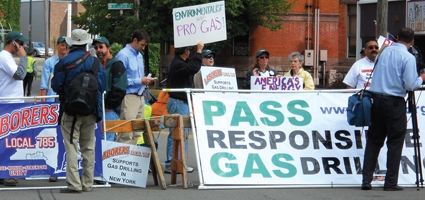
Binghamton police blocked streets and kept barricades in place yesterday to control the crowds anticipated at the second EPA hearing this week in Binghamton on the safety of the high water volume horizontal drilling method. It was the last of four public hearings on a pending study of fracking.
Energy companies drilling into the lucrative Marcellus in Pennsylvania, the Barnett in Texas and the Haynesville in Alabama have been employing the controversial technique to release natural gas deposits within the tight shale formations. Instances of ground and surface water contamination at some well sites, particularly in Dimock, Pa., have been blamed on the fracturing fluid mix of water, sand, soap and chemicals. Those accidents and others from other states have prompted the U.S. Congress to direct the EPA to study whether the technique should be regulated under the auspices of the Safe Drinking Water Act rather than left to the states to regulate.
But less than a dozen protesters on both sides of the issue faced off in front of the Forum, compared to reports of several hundred on Monday. Inside, about 300 listened and participated in the hearings. Pre-registered speakers were given two minutes in which to voice their opinions.
After those speaking during the first half of the afternoon’s roster were heard, it was apparent that the anti-drilling contingency was more vocal. They spoke on their own behalf as citizens and landowners, or as municipal and county legislators, and representatives from Rep. Maurice Hinchey’s office. Environmental advocate groups such as the Greater Catskill Gamekeepers, the Sierra Club, the League of Women Voters and others were well represented.
Most said the specific chemicals formations used in fracturing fluids weren’t being identified, and posed a risk to the quality of water and air. Dan Lamb, of Congressman Hinchey’s office, said there existed an “unacceptable knowledge gap about hydrofracturing. What we don’t know, can hurt us.”
Others opposed used such phrases as: “It’s not the economy stupid, it’s the geology,” referring to the pro-drilling side’s contention that natural gas development in the region would lift farmers and the poor out of economic despair.
Most said the migration of chemicals left underground after fracturing isn’t understood because the geology of shale is irregular and fissures occur naturally over time. Others pointed to the briny water and radioactive bits of rock brought back to the surface with the natural gas.
A Sierra Club representative said no municipal water treatment plants should be taking fracking fluid because they aren’t built to handle such high concentrations of brine. All questioned whether states’ environmental conservation agencies could handle the workload that would be required to monitor drilling.
On the other side, the proponents asked the EPA not to be swayed by public opinion, but to stick to Congress’ mandate to study the drilling technique only as it relates to the Safe Drinking Water Act. They repeated: “Do the science” and referred the panel to the U.S. Petroleum Research Council for facts.
Many speakers supporting shale drilling said well accidents weren’t being accurately reported, and that methane gas has been present in homeowners’ wells in New York for decades.