NORWICH – The controversy over natural gas exploration is being driven by emotions and politics rather than sound scientific theories, according to proponents of the industry who sat on a panel Wednesday during Commerce Chenango’s most recent Good Morning Chenango! breakfast.
The event, attended by more than 80 local business people, was designed to shed light on Chenango County’s budding natural gas industry, and the economic potential and environmental concerns associated with it. The breakfast, held at the Howard Johnson Hotel in Norwich, was sponsored by Frontier and catered by Carmen’s Cafe.
“We want our members to be educated about the issues surrounding natural gas,” explained Commerce Chenango President Maureen Carpenter.
The panelists were eager to oblige, particularly when it came to clearing up what they called “misinformation” about natural gas drilling and the process of hydrofracking in particular.
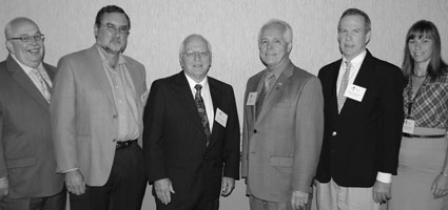
“The process of hydrofracking has not polluted one water well,” reported Assemblyman Clifford Crouch, who sat on the panel along with Dennis Holbrook, Executive VP of Regulatory, Public and Investor Relations for Norse Energy; Chenango County Natural Gas Consultant Steve Palmatier; and Bob Williams, Dir. of Environmental Studies with Barnes-Williams Environmental Services.
According to Crouch, New York already has approximately 13,000 natural gas wells, most of which have been “fracked ”- a process which involves the use of water, sand, and chemicals to open minute fissures in rock deep beneath the surface to extract natural gas. While opponents of natural gas drilling often cite issues in Colorado and Wyoming as evidence of the dangers of hydrofracking, Crouch said the problems found there are related to surface spills and containment of fracking fluids, and not the process itself.
His statement was supported by Holbrook and Williams, the latter of which reported that the Joint Landowners Coalition of which he is a part has confirmed this with each of the 28 states in the United States which allow hydrofracking.
“Either all of these states are lying, or there really isn’t a problem with hydrofracking,” Williams said.
Holbrook said many of the problems highlighted by the media in the Western states and in Pennsylvania are already addressed by New York, which has the most stringent regulations in the country.
“We do not lack for regulatory oversight in this state,” he said, explaining that was a complement to the DEC. In fact, he went so far as to praise the agency for its exhaustive efforts in regard to the SGEIS, which totals some 900 pages.
Holbrook said natural gas extraction has never been about a “trade off” between economic potential and environmental risks.
“Someone else framed this issue,” he said, adding if that were in fact the case, “we have no business being here.”