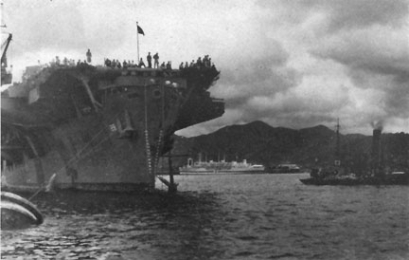
Throughout the course of history, many personal memories have been recorded, first in letters, later in phone calls, and in the present day, e-mail. In the early centuries, the mail was the principle for a soldier, sailor, Marine or Coast Guard member to keep in touch with their loved ones at home. This enabled wives, fathers, mothers, sisters and brothers that know that when the letters were written, their loved ones were well as could be under circumstances and hopefully their correspondences would be answered in a timely manner by the receiver. During World War II this was a principle means of communication. The memories written by naval participants who were assigned to the USS Chenango were numerous.
A salute to these written memories of the men who served on this ship are excerpted below, written in part as they were remembered.
Captain Alvin Malstrom, a graduate of the United States Naval Academy in June of 1922, was after many years of service detached from the Enterprise in June of 1942 and assigned to the conversion of the Chenango at Staten Island, New York. Two months later she sailed from the East Coast to French Morocco with decks packed with planes (Warhawks) to be assigned to Port Lyautey. The Chenango launched her plans off the French Coast without a single accident and would return to the United States, badly damaged during a hurricane (written previously) and put in to port at Portsmouth, Virginia for repairs. Captain Malstrom would be assigned to the USS Sangamon in February of 1945 and proceed to the Pacific war area where the Sangamon would participate as an escort carrier in the assault and occupation of Okinawa, Guam. On May 4, his ship would be hit by a Kamikaze plane exploding in the center of the flight deck.
Captain Malstrom was awarded the Silver Medal and the citation received is quoted as written: “For conspicuous gallantry and intrepidity ... during operations against enemy Japanese forces in the vicinity of Okinawa on May 4, 1945.” The citation further states, in part: “When his ship was severely damaged by an enemy suicide plant and raging fires broke out on the hanger deck and among gassed and armed planes on the flight deck. Captain Malstrom directed the fire-fighting operations from the bridge until the island structures were enveloped in flames, causing intense hear and suffocating smoke. Beset by darkness, low water pressure caused by broken risers and temporary loss of electrical power, as well as by complete absence of communications, he continued to direct overall fire-fighting activities which resulted in the saving of his ship ...”