After the close of the Civil War, the United States Navy went into a stage of decline and by the time of President Garfield’s administration in 1881 it had deteriorated so far that a survey was conducted and found that only 52 of the Navy’s 142 vessels were operational. However at the start of the 1880s, naval officers were extremely alarmed about the vulnerably of the nation as a whole. This alarm finally led to a half-dozen large modern warships – transforming the Navy so suddenly that it became to be called “The New Navy.”
The Navy, as written previously, has participated in the many conflicts that the United States has been involved, a role that is still prevalent in this dangerous 21st century. There are many photos available showing the different war ships of the Navy over the years from the first battleship “The USS Texas” - commissioned 1892 - to photos of The Flying Squadron,1898, to The Great White Fleet in 1907 to the USN’s first aircraft carrier USS Langely to the photo of General Douglas MacArthur signing the Japanese surrender document aboard the USS Missouri.
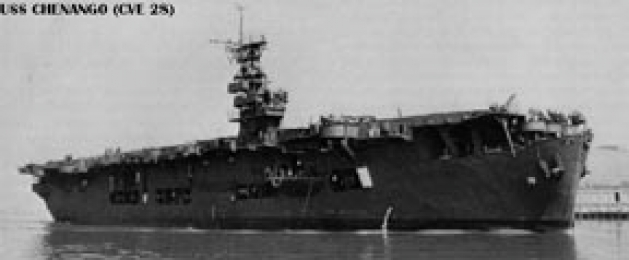
However, to return to a segment of history that is little known in this part of the world is the participation of the USS Chenango in World War II.
The USS Chenango’s life did not begin with its participation in World War II, but as a civilian tanker Esso New Orleans built under a Maritime Commission (AO-31) and owned by Standard Oil Company. She was constructed by the Sun Shipbuilding and Dry Dock Company of Chester, Pennsylvania, first “laid down July 10,1938” sponsored by Mrs. Rathbone and launched April 1, 1939. After being commissioned, The Chenango was assigned to the Naval Transportation Service and provided tanker duty in the Atlantic, Caribbean, and Pacific as far as Honolulu. It was in Aruba, N.W.I. February 16, 1942 when a German submarine shelled one refinery on the island. After that beginning action (a prelude of the war to come), she was decommissioned March 16,1942 for conversion to an escort carrier.
After this conversion was complete (ACV-28) on September 19, 1942 and carrying Army aircraft , the Chenango sailed October 23rd with the “Torch” assault force bound for North Africa and November 10, flew off her aircraft to the newly captured Port Lyautey, French Morocco. Completing this mission, she put into port at Casablanca November 13, refueling 21 destroyers and returned to Norfolk, Virginia November 30, crossing the Atlantic during a hurricane which caused extensive damage to her.
Repaired, the Chenango sailed for the Pacific in mid-December and arrived in Numea Jan. 13, 1943. She joined the escort carried group which provided air cover for supply convoys which were supporting in the participation of the Solomon Islands. At that time, one of her air groups was forwarded to Henderson Field, Guadalcanal, giving close support to the Marines ashore. A major duty of Chenango was to provide sentry duty off this hotly contested island. The capture of Guadalcanal is well documented in assorted history books, movies and need not be repeated again here!