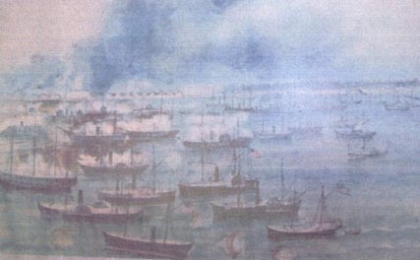
With the advent of the Civil War, the United States hastened the end of the sailing Navy and April 20,1861 the Union set fire to all ships in dock at the Norfolk Navy Yard to prevent them form being captured by the Confederates, however not all ships were completely destroyed.
As was written in the first segment of these articles, blockading the southern ports was a major role for the ships flying the Union flag. One such was the USS Chenango. This side-wheelsteamer was first launched March 19, 1863 by J. Simonson of Greenport, New York. The USS Chenango (so named for the river and county in central New York and the reasoning for this designated name is not known) was outfitted at the New York Navy Yard and formally commissioned Feb. 29, 1864 with Lieutenant Commander T.S. Fillebrown in command.
Leaving New York for Hampton Roads, Virginia April 15,1864 she was assigned to the South Atlantic Blockading Squadron. The photo of the map (taken from the American Heritage book “Civil War” by Bruce Catton) illustrated the slow strangling effect of the Northern Blockade in closing Confederate ports. This photo is the strangulation of Fort Fisher in South Carolina in which the USS Chenango participated in.
Before the Chenango reached the open sea, one of the boilers exploded, scalding 88 men fatally. The resulting raging fire was brought under control, extinguished by the courageous work of the ship’s crew and consequently was towed back to New York for repairs. The Chenango was placed out of commission April 21, 1864 and repaired, refitted and recommissioned February 1, 1865.
Regarding the USS Chenango Boiler Explosion, April 15, 1864, a lengthy documentary was written by Terry Foenander and a portion of his documentation is quoted in this article.
“Leaving Friday, April 15, 1864 the ‘Chenango’ steamed out of the Navy Yard in New York for Hampton Roads and was to drop anchor at the buoy at Sandy Hook till the next day when she would be accompanied by the double turreted monitor, USS Onondaga, assigned to her destination in the south.”
Lt. Com. Thomas Scott Fillebrown was in command, a veteran of over twenty years of service, entering the United States Navy in October of 1841. He had only recently been assigned to the ship and her complement of about two dozen officers included several engineers, controlling the engine room, under the eye of their first assistant engineer, Joseph N. Cahill.











