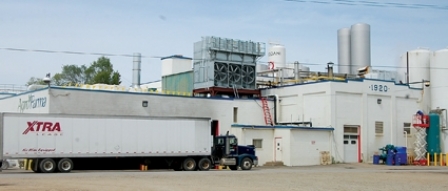
COLUMBUS – Officials from the Greek-style yogurt plant cited last month for DEC violations say they are diligently working to comply with the state agency’s deadlines.
“AgroFarma is doing everything possible to eliminate odor and waste water non-compliance issues through engineering improvements while building toward sustainability and internal energy generation on the site,” reported Keven Bucklin, vice president of operations for the Town of Columbus-based yogurt manufacturer.
The company has been a victim of its own success.
“We have grown to be the #1 yogurt in the Northeast and the #1 brand of Greek yogurt in the country,” Bucklin said. Chobani was recently named by Prevention Magazine as one of the top pre-packaged foods for women.
To keep pace with demand for their product, AgroFarma has had to ramp up production significantly. According to Bucklin, when he started at the company in March of 2008, they were producing approximately 20,000 cases a week and employed roughly 30 employees. Now, the plant churns out 400,000 cases a week and employs upwards of 200 full- and part-time staff.
To produce that volume of yogurt, the plant receives approximately 1.1 million pounds of milk per day, all from a local cooperative. Approximately 75 percent of that volume goes back to the farm as fertilizer, Bucklin reported. That fertilizer is a combination of whey, which is strained from the yogurt during the production process, and sludge from the plant’s waste water treatment facility, Bucklin reported.
The sheer quantity of by-products from making the yogurt is the problem.
“The volume of production at our plant here in South Edmeston has pushed us past the capacity of our wastewater treatment system,” he explained.
According to Bucklin, the yogurt manufacturer starting planning to upgrade the system early last year as it began adding production capacity at the plant. The first phase of those plans, he explained, involved installation of a Dissolved Air Flotation (DAF) clarifier. This equipment, which removes suspended solids from waste water generated by the plant, went online in February of this year.
The second phase, to convert the existing sludge tank to an aeration tank, was completed on May 8, he reported, and should be fully operational within a few weeks. Phase three, which Bucklin said should be completed by August, includes the installation of an equalization tank. Details are still being finalized for the fourth and final phase of the project, which will include installing a larger clarifier, with which the company hopes to be able to generate some of its own energy.
According to Bucklin, each phase of the upgrades to the waste water treatment facility was scheduled to be done in conjunction with the company’s anticipated growth. However, parts of the project were delayed as they evaluated available technology. Plans for each phase also had to be submitted to the DEC for their review and approval.
“They’ve been very supportive of all of our upgrades and all of our changes,” Bucklin said.











