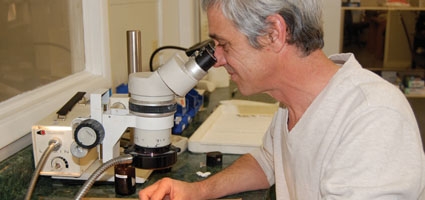
GREENE – Most people hear “optics” and think eye glasses or camera lenses, but that is a far cry from the niche market served by Bill Kutz and the business, K&S Optics, which he recently relocated to Greene.
“We don’t do a lot of consumer work,” Kutz explained. That’s not to say that the general public isn’t familiar with his work.
“I guess our claim (to fame) is all the shuttles have our optics on them,” he said, explaining that the robotic arms on each of NASA’s space shuttles employ between 16 to 18 lenses produced by his company.
In fact, the commercial and precision grade cylindrical lenses, flat optics, beam-splitters and prisms Kutz and his team craft are used as components in the aerospace and defense industries as well as high-tech medical equipment and scientific instruments.
“They go into bigger assemblies,” he explained. According to Kutz, K&S Optics is one of only six to eight companies in the country which produce some of these optical components.
Kutz has 28 years of experience and an excellent reputation in the highly specialized field. A past board member of both the American Precision Optics Manufacturing Association and the Optics and Electro-Optical Standards Council, he has played a key role in writing standards for the optical industry. He also has a reputation for being creative and innovative.
“People know that if they can’t get something done, they come to us,” said Kutz, who says many of his customers come to him by word of mouth.
The optics which K&S creates are so specialized that they custom design and build much of their own equipment. Kutz and his team deal in surface flatness tolerance levels in the ten-thousandths of an inch, and measure flatness in sub-angstrom levels, smaller than the diameter of a hydrogen atom.
While some of the equipment they use in the process involves high tech computers, the science behind what they do dates back centuries.
“We basically grind the lenses the same way Galileo did,” Kutz said.
But using the term “grinding” may be misleading, since it implies simply a mechanical process, while this process is chemical as well.
“We’re basically moving molecules to get the shape that we want,” he explained. The process can take as little as a day, or up to several weeks, depending on the lens.
According to Kutz, most of the optics they create are crafted from glass, of which their are some 2,000 types. Each bends light differently, he explained, and allows different wavelengths of light to pass through. Thermal properties vary as well, both in glass and other raw materials they work with, such as crystalline structures, he explained.











