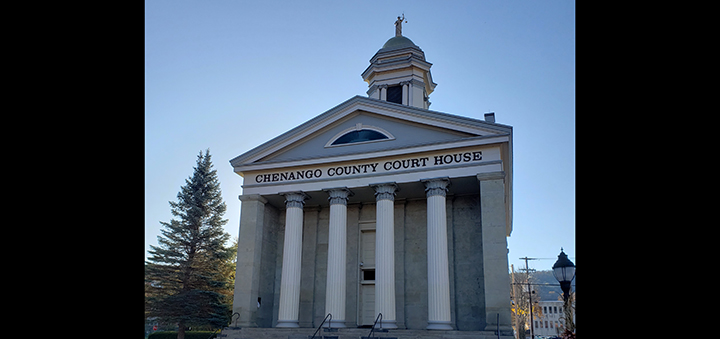
NORWICH – Chenango County’s 911 communications system was scheduled to go live this month, but with installation adjustments – and a final cash call – officials don’t expect to see the light at the end of the tunnel (or in this case, tower) until fall.
The project has been underway for more than a decade. It replaces a system of three towers constructed in the 1970s: one in Otselic, one in Coventry and one on Barnes Hill in Norwich. The three gave coverage to only about 25 percent of the county. Replacement parts simply didn’t exist for the antiquated microwave system, and the towers themselves weren’t tall enough to support newer, more technologically advanced antennas.
“I don’t know how many times I was told if it went down, we would be done,” said longtime Chenango County Board of Supervisors Chairman and former police officer Richard B. Decker, R-North Norwich.
When the county’s now nine-tower system goes live in September or October, 98 percent of the county will be covered at a 95 percent rate. A state-of-the art 911 communications system is something that Chenango County has never had before and can now be proud of, Decker said during a recent interview.
“With public safety as a cornerstone in the county, this is what we were after. We can communicate easily. It’s important to put safety first,” he said.
The county board’s decision in February to make a final cash infusion of $200,000 to the project’s consulting engineers wasn’t without question, however. Supervisor Jerry Kreiner, R-Plymouth, said he was frustrated that the engineering consultants weren’t “looking down the road for us” to avoid more costs. Supervisor James B. Bays, D-Smyrna, concurred, saying, “They had their responsibilities, now we are paying additional money for it.”
A handful of supervisors have repeatedly questioned multiple aspects of the new 108,000 square foot Public Safety Facility on Upper Ravine Road in the Town of Norwich as well as the 911 tower project – especially because a 1 percent sales tax was imposed county-wide to afford them. But it has been Supervisor Peter C. Flanagan, D-Preston, who most often raised questions through the years about the funding details.
A tally of expenses and revenues obtained from the county treasurer’s office shows the cost of the Public Safety Facility capital building project to be $25.2 million and the Public Safety Communications capital building project to be $5.8 million. When combined, the total $31 million amount is a far cry from what Flanagan said was an approved budget of $26 million for both phases of an overall Public Safety Facility project. (See sidebar.)
When the new Sheriff’s Office and Jail on Upper Ravine Road in Norwich opened in 2007, former Sheriff Thomas J. Loughren and Chairman Decker publicly announced that it was built for about $1 million under the $26 million originally budgeted. Flanagan said he took particular exception to those claims, further pointing to the treasurer’s office data that doesn’t entirely account for “about $3 million” that, as he recalled it, was set aside for “communications.”
A large portion of the $5 million overage can be chalked up to the fact that the three towers originally targeted ballooned into a total of nine, including the main tower at the site. But, indeed, when the communications capital building project was approved in 2007, Chairman Richard B. Decker often referred to it as “Phase II.”
“It’s not the right way to put it (that the entire project was over budget),” Decker said in a recent interview in response to Flanagan’s assertions. “Perhaps that was my fault for calling it that (Phase II). They were two separate projects from the beginning.”
Flanagan said the original planning document for the overall project included an estimate of $3 million for emergency management communications. When the Chenango County Board of Supervisors finally stamped their approval of it, the amount had been slashed to $2.58 million. Much later, as the building was nearing completion, it was announced that about $760,000 was leftover to attend to the towers.
Flanagan’s claim would therefore be more like $2.24 million that went into other aspects of the project rather than the 911 tower project.
Upon learning that the budget for communications had been cut, members of the Chenango County Fire Advisory Board and Emergency Management Services Board protested at the time. However, when contacted for this article, neither Robert Handy, retired county fire coordinator, nor the current Advisory Board Chairman Mike Cobb could remember just exactly what the original planning documents has included for emergency management communications.
“The numbers were so difficult to follow that I finally stopped asking questions,” said Handy, who was fire coordinator for 23 years before stepping down in 2005.
Chairman Decker and Chenango County Emergency Management Services Director Matt Beckwith recently explained that the communications portion budgeted within the $26 million was earmarked only for telephones, computers, the 911 dispatch consoles, and to construct, but not equip, the main tower. It was not intended for improving the three existing towers, nor adding on any more, Decker said.
Despite efforts, The Evening Sun was unable to obtain the original planning documents that budgeted an amount for communications within the original $26 million. But taking the approved amount of $2.58, and after a lengthy investigation of the costs as per conversations with Decker, Beckwith, Young, Treasurer William E. Evans, and Clerk of the Board RC Woodford, it appears that $1.82 million was spent to construct one tower and install telephones and computers within the facility.
The figure appears out of proportion when compared to the $5.8 million spent to construct eight towers and equip all nine. Despite several calls to his office over the course of this investigation, Beckwith could not be reached to confirm the price for equipping a tower. Decker said the price for constructing one tower was normally between $800,000 and $1 million.
To complicate things further, Sheriff Loughren often referred to state grants that were awarded for the dispatch center. The exact amounts weren’t easily identified on the treasurer’s office statements, and Chenango County Deputy Treasurer Ardean Young said he wasn’t familiar with any state grants.
“If they did receive them, they were set up to go directly through DASNY (the Dormitory Authority of the State of New York, the project’s primary consultants),” said Young, deferring the question to Beckwith.
Beckwith confirmed that the sheriff’s office dispatch center was built with “about $1 million in grants.”
Two other costs that don’t appear on the statements are for change orders put through by DASNY for both projects and something the Chenango County Public Works Committee has always kept track of: About $300,000 that was spent in house by the county’s public works department in order to clear the Upper Ravine Road site.