NEW BERLIN – In January 2007, the emergency medical services (EMS) of Chenango County were dealt a serious blow with the announcement that Superior Ambulance was pulling out of the area.
Left with a void of advanced life-support service, volunteer crews and local governments came together and created the paid ambulance service of New Berlin. The efforts of the Village and Town of New Berlin and the Town of Columbus along with the contributions of volunteer firefighters and paid staff makes possible today’s 24-hour, seven day a week ambulance service.
New Berlin Fire Chief Shawn Patrick said the New Berlin Fire Department, like many others in the area, has traditionally provided volunteer EMS services since the 1950s. However with trends now leading local departments to paid staff, that is no longer the case.
“According to state law, a volunteer fire department can only run a volunteer ambulance service. Once you start paying the members, they have to be separated from the department and made into a separate organization,” he said.
Volunteer fire service members still aid the EMS service by driving the EMS vehicles and in providing support any way they can however, Patrick explained.
The New Berlin Fire Department’s history dates back to 1955 when Wesley Aylesworth, Herb Butts, Harry Prentice and Merritt Lloyd started the all-volunteer emergency squad. The EMS service was in place until 1999 when the department changed to the New Berlin First Response EMS unit, primarily due to a shortage of manpower.
Gray’s Ambulance Service of Norwich then became the area’s primary emergency transport service, followed by Superior Ambulance until October 2007, when that provider pulled out of Chenango.
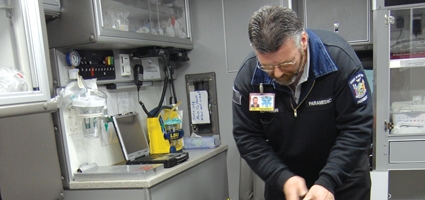
New Berlin Paramedic Seth Johnson began working for the local ambulance in May, before that he worked for Superior Ambulance for 12 years.
“Even before Superior came into the region, there was a general decline in the availability of EMS volunteers. Nothing like today, but you could see where it might be going. When Superior came in, they reduced that burden of Advanced Life Support from fire departments who continued to maintain first responders,” he said. Johnson said Advanced Life Support crews had at least one fully qualified paramedic and other capabilities the first response crews did not have.
“After a period of time these areas basically became dependent on the private ambulance service and when they decided to leave, there was a much bigger gap then when they first arrived, leaving a lot of areas basically lacking in coverage,” said Johnson.
Patrick said a decline in volunteer EMTs has been the bulk of the EMS provider problem. A lack of funding and down-turned economies have also added to the issue, citing state requirements, stricter jobs, and changes in family structure.