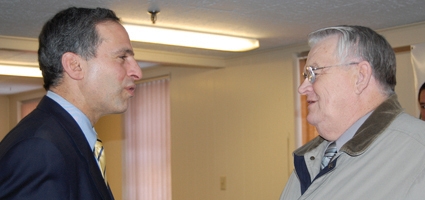
NORWICH – Route 12, healthcare, jobs and gas drilling topped the list of concerns local business and elected leaders shared with Congressman Mike Arcuri during an economic roundtable held at Commerce Chenango Thursday.
Approximately 20 local leaders, including elected officials and representatives from area businesses, attended the event, which was one of several stops the New York Democrat made during his visit to Chenango.
For representatives from Unison and Raymond Corporation, improvements to the Route 12 corridor was a priority.
“What can we do to push it?” asked Unison’s Director of Operations, Gary Cummings, who has voiced his concerns about the safety of the aerospace component manufacturer’s more than 280 employees who travel the state highway to and from work each day.
Raymond’s Pete Komendarek echoed Cumming’s concerns referencing the material handling equipment manufacturer’s 800 local employees as well as the volume of trucks which transport goods in and out of the company’s Greene facility.
“It’s become a bottleneck for us,” said Komendarek, who came to the meeting armed with the proposal initially prepared by the Route 12 Improvement Committee, dated July of 2002, to illustrate how long local leaders had been advocating for upgrades to the roadway.
Arcuri assured both that improvements to the transportation corridor remain a priority for him.
“The longer we put off doing 12, the worse he gets,” he said. While he and Senator Charles Schumer have secured roughly $1 million in appropriations for the project, he said this is only a “drop in the bucket” of what will be needed to complete the planned work.
Dr. Drake Lamen, president and CEO of Chenango Memorial Hospital, shared his concerns with Arcuri regarding the difficulties hospitals, particularly small rural facilities, have in recruiting physicians.
According to the hospital administrator, one of the problems is the high costs of attending medical school. New doctors graduate with up to $150,000 in school loans, he explained, making it impossible for them to go into private practice. And in order to recruit them, hospitals must pay large sign-on bonuses and salaries, making it even more difficult for them to cover expenses.
“Reimbursements go down, expenses go up,” Lamen explained, and hospitals get “squeezed” in the middle.
“If we can’t get physicians, then we can’t provide services; it’s that simple,” he said, suggesting that measures other than scholarships and school loans need to be explored.
Arcuri said he recognizes the need to “incentivize” nurses and providers to work in rural areas.