CHENANGO BRIDGE – A Smithville Center woman wore a toxic waste drum and handed out fake one thousand dollar bills. A woman from Marathon helped hold up a sign accusing New York state regulators of being the puppets of big industry.
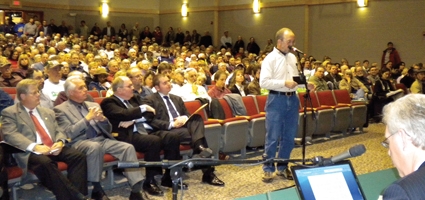
And the words “the poor farmers need the money” could be heard often upon entering Chenango Valley High School Thursday night for the second in a series of public hearings on proposed environmental regulations for permitting natural gas drilling into the nation’s largest gas reserve, the Marcellus Shale.
The first, held in New York City earlier this week, attracted similar protests, with one individual storming the stage yelling and, afterward, being escorted out.
But the more than 1,000-member audience that packed the school’s auditorium to the brim were predominantly pro-drilling and asked the Department of Environmental Conservation to lift the ban so natural gas companies could begin their work immediately. More public officials and leaders of land coalitions (who were often one and the same) than environmental activists took the microphone during an orderly, controlled comment period.
“I’m surprised,” said Chenango County Farm Bureau President Bradd Vickers observing the crowd. “I thought there would be more protest.”
About 15 government officials representing Broome County, from the City of Binghamton to the towns of Conklin, Barker, Sanford and others, were joined by state Assemblymen Clifford Crouch, R-Guilford, Gary Finch, R-C, Springport, and Assemblywoman Donna Lupardo, D-Endwell, to present their comments first. And most of the elected representatives stayed to hear the public do the same.
“The vast majority of the people I talk to are pro-drilling, but are concerned that it be done right. ... I tend to think we can move forward with due diligence,” said Crouch.
The other Assembly representatives present echoed Crouch’s vow to “do everything in my power” to find the funding that will staff the DEC with enough boots on the ground to control the wastewater from drilling.
“It’s vitally important that we get it right,” said Lupardo. “There’s a lot of pressure to move forward and a lot of pressure to step back and get it right. Take this time on the front end to get this correct.”
Lupardo also called for adequate infrastructure at the state’s Public Service Commission, something Vickers and the Farm Bureau has called for repeatedly. The PSC only monitors pipelines that are a certain pressure despite there size, and has no controls over where they are.
“The PCS should monitor all of them regardless of their pressure. People digging shouldn’t accidentally discover them,” Vickers said.
Vickers would add that stipulation to the 800-page draft drilling regulations. Other suggestions made by both drilling proponents and the opposition were: using alternatives to the millions of gallons of water needed to drill, disclosing the chemicals contained in the fluid needed to frack the shale and release the natural gas, odorizing the gas so it can be traced through transmission lines, dying the fracking fluid so it can be traced as well, and having cultural consideration for the people who were here before us.
Other suggestions were for stormwater checks, spill containment, open pit capacity limitations, more stringent drilling and casing requirements, and water well testing before and after drilling.
Opponents like Town of Chenango landowner Glen Williams said they worried their water would be polluted by radiation found in formation water extracted after drilling as well as by the chemicals in the fracking fluids used to drill. Williams said he had recently refused a lease check of more than $5,000 per acre on his land because he feared for the water acquifer.











