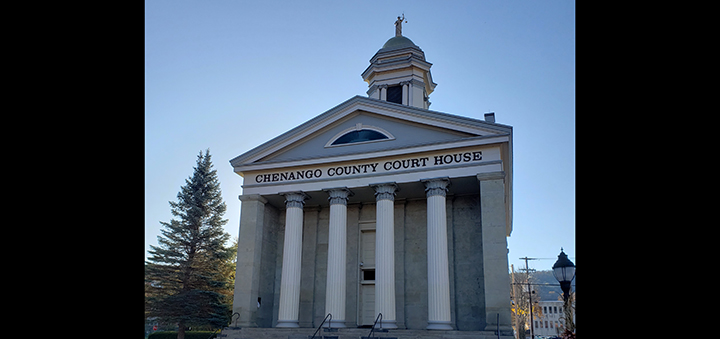
NORWICH – The final cost of the public defense in the Peter M. Wlasiuk murder trial has been submitted to the Chenango County Public Defender’s Office and totals over a quarter-million dollars.
Responding to a Freedom of Information Act request from The Evening Sun, Public Defender Alan Gordon released the newly-billed amounts against the strenuous objection of the attorney assigned in the murder retrial, Randel A. Scharf of Cooperstown.
Speaking to The Evening Sun earlier this month, Scharf said the payments approved by the court were sealed documents and publication of the information could expose the Public Defender’s Office and the newspaper to a possible lawsuit.
“Those orders that are filed, that have to do with any payment, are files that are sealed and are extremely sensitive,” said Scharf. “You don’t have any right to file for any confidential information.”
However, Gordon and the presiding authority in the case, Broome County Court Judge Martin E. Smith, who signed the payment orders, disagreed and both offices said the information could be made public.
On Sept. 30, the Public Defender’s Office received a court order from Smith to pay an additional $108,966.44 on top of the already-claimed $149,490.87 in approved expenses for Wlasiuk’s defense.
Altogether, the case has cost the county $258,457.31 in direct defense fees. No one seems able to estimate the prosecution costs associated with the District Attorney’s Office, Chenango County Court, Sheriff’s Office or the New York State Police, since there is no quantitative way to track the expenses in the daily routine work of the agencies. No representative contacted from any of the agencies was willing to make an estimate.
Wlasiuk, 40, was charged with second degree murder in the April 2002 death of his wife, Patricia. Prosecutors contend Wlasiuk killed his wife at their Oxford home and later staged a Guilford Lake, in which he claimed she drowned.
Six years ago, a Chenango County jury convicted Wlasiuk of second degree murder, but the New York State Appellate Division overturned that verdict on Aug. 31, 2006, citing a “litany of errors.”