NORWICH – While teen drivers only account for a fraction of the total miles driven in the United States each year, they make up a disproportionately high percentage of accident fatalities.
“Don’t let that be you,” said Trooper Richard Siefert, a 24-year veteran of the New York State Police, as he addressed the 81 Norwich High School students enrolled in the school’s 6-week driver’s education program.
According to the long-time law enforcement officer, if teenagers would just buckle up, slow down and stay off their cell phones while driving, they would not only reduce their chance of having an accident, but increase their chances of surviving one as well.
New York State Trooper Peter Grunder, who serves as the school and community outreach coordinator for Troop C, accompanied Siefert to Norwich High School. Together they gave a two-part presentation on the importance of wearing a seat belt and factors which contribute to motor vehicle accidents, particularly among teens.
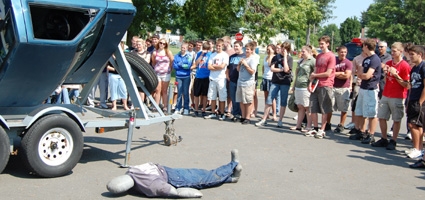
Using a specially designed simulator, the state police officers demonstrated what happens to passengers who are not properly belted in when a vehicle is involved in a rollover accident at 25 miles an hour.
“Rollovers account for a tenth of all accidents, but one fifth of fatalities,” Grunder explained. This point was driven home to students when, on one of the first revolutions, the toddler-sized crash dummy which had been unrestrained in the passenger compartment of the simulator was thrown from the vehicle.
“Weight times speed is the force that is on you in an accident,” Grunder said, explaining that at a crash speed of 30 miles an hour, there would be 300 pounds of force on a 10-pound child. “There is no way you could restrain that child in an accident.”
In a second demonstration, the adult-sized “driver” was first partially, then fully ejected from the vehicle to land with a thud on the asphalt.
Helping to illustrate the State Police Officers’ message was the fact that the third passenger in the vehicle, an infant in a car seat, remained secured in the vehicle during both demonstrations.
“The seat belt keeps you in and lets the car keep you safe,” Siefert said. “You can’t prevent all crashes, but you can put your seat belt on every time.”
The students then moved inside, where they heard startling statistics about teen accident deaths and the factors that contribute to these crashes.
According to Siefert, teen drivers have the highest crash risk of any age group. More than 55,000 teenagers die in motor vehicle accidents in the U.S. each year, making it the leading cause of death among American teens. Another 450,000 are injured but survive these accidents, he said, and 30,000 are hospitalized.