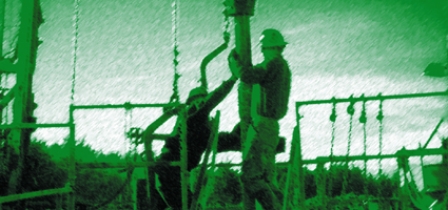
NORWICH – The low drone from drilling rigs can still be heard through the hills and dales of Smyrna, landmen have begun to infiltrate further north into Madison County and rumors are flying about more lease deals coming to Broome County property owners.
All that activity should be enough to spur state lawmakers into completing the Marcellus Shale permitting process, a group of Chenango County supervisors say – not to mention the constant bombardment of communiqué over the Internet from local government officials, environmentalists, landowner coalitions and natural gas industry lobbyists.
The New York State Department of Environmental Conservation is supplementing its environmental regulations for hydrofraking permits in the natural gas rich Marcellus Shale. The update was to have been completed in March, but isn’t expected now until fall. Industry followers say many companies are lined up to drill once permits can be issued.
“Very simply, what else is in New York? This is an opportunity that is almost certain,” Chenango County Supervisor Peter C. Flanagan, D-Preston, and chair of the county’s special committee on natural gas, said Tuesday.
A rally scheduled for Aug. 23 in Bainbridge, sponsored by 23 Central New York coalitions, aims to provide a forum for landowners to ask their elected county and state officials, including Governor Paterson - who will all be invited - why the DEC’s Supplemental Generic Environmental Impact Statement is being held up.
“We’re going to get an invitation. I suppose they’ll have a seat for us and if we’re not there ... The way I understand it is we are going to be asked to weigh in on the state. They want to know why no SGEIS yet, and ask us: ‘What are you doing about moving things along?’” said Flanagan.
Bryant LaTourette, whose coalition, the Oxford Land Group, is sponsoring the rally, said in a press release that gas drilling “is being impeded by undue delay at the DEC.”
Members of the Chenango County Natural Gas Committee speculate that the document is being held up by state legislators posturing for a severance tax on production.
Another factor could be environmentalists and their downstate supporters who have called for a moratorium on hydrofraking in the New York City Watershed in the Upper Delaware River. They say both surface water and underwater aquifers could be threatened by the chemicals in hydrofraking solutions, formation water and spill accidents.
DEC Spokesman Yancey Roy said yesterday the SEIGS is delayed because “third party information,” or technical information from the industry itself and its consultants, has taken longer to obtain.
“As for the time frame, DEC is dealing with a number of consultants, technical advisors, and state agencies, and though no one particular sector is to blame, if one consultant is a week late, then it pushes someone else back a week or two. The state is trying to be comprehensive in its review and given a project this size, a small slippage in the time frame isn’t unusual,” said Roy.
The Albany legislature made a stab at instituting a five percent severance tax on natural gas production earlier this year. Though the bill fell off the table, those following the natural gas industry say it’s only a matter of time before a new tax is proposed. Currently, there are as many as eight possible laws relating to the gas industry on the legislative agenda.
Supervisor James Bays, D-Smyrna, has suggested a resolution on behalf of the Chenago County that would up the compensation to locales where the actual drilling impacts are felt. Smyrna is home to 13 producing wells and the target of many more in the future by Norse Energy, Inc. of Norway.
“Under the present system, we do not feel that the compensation is sufficient to localities. We do not agree that they are adequate,” he said.
Currently, a total of 16.5 percent of natural gas production goes to the towns (1 percent), to schools and special districts (3 percent), and to property owners (12.5 percent). Norse’s real property tax contributions in Chenango and Madison counties over the past two years is approaching a quarter of a million dollars, a company spokesman said.
However, the county’s gas committee has debated the way natural gas is taxed at length and now come full circle to recognize that the current real property tax system - although “convoluted,” said Town of New Berlin Supervisor Ross Iannello - might actually result in more local collection than if the state imposed a new tax.
“We may not have that political power to open that can of worms and get a better return than we are under the present system,” said Flanagan.
As for local road preservation, Iannello said existing law that was adopted several months ago in New Berlin requires companies to post bond with the town’s highway superintendent before testing and drilling.
“We’ve tied it to commercial projects, exempting milk haulers and oil trucks, but including loggers. We’re better off to protect ourselves rather than have a severance tax,” he said.
Other agenda items discussed were landmen’s leasing tactics and whether they should be licensed. Steven Palmatier, a proposed consultant to the county’s Planning and Economic Development Committee, said he learned that New York State law exempts landmen from licensing because they work on a per diem basis without commission and travel independently from state to state.
“I can see where they should be licensed. We would be well served by a little more disclosure of the companies they are working for,” said Iannello.