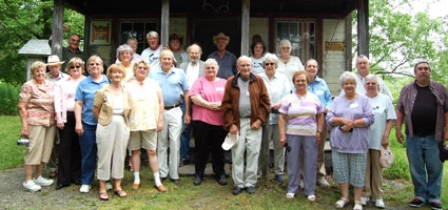
COVENTRY – More than twenty local history buffs had the chance to learn about the rich history of Coventry last month, when the town hosted the Chenango County Historian’s Spring Meeting. Attendees, a mix of historians and historical society members from across the county, were treated to a tour of some of the most notable historic locations in Coventry and Coventryville during the event, which took place on June 24.
At each stop along the tour, participants not only learned about the town’s storied past, but were also able to help “fill in the gaps” in some instances with their own extensive local knowledge.
“This part of the state is very rich in history, but most people don’t know it,” said Coventry Historical Society Member Lee Stockton, who enjoyed the opportunity to share his keen interest in and knowledge of local history with the like-minded individuals who participated.
The group gathered for coffee and doughnuts in the Town Hall, located on State Hwy 235, before moving next door to the first stop on the tour, the Coventry District #4 School House. According to Town of Coventry Historian Phyllis Lerwick, the one-room structure was built in 1900 and remained in use as a school until 1956.
“The town purchased it several years ago,” Lerwick explained. Since that time, the stone foundation has been replaced and the exterior painted, but a complete restoration is on hold as the town applies for grants to fund the needed work.
Despite the peeling paint and musty smell of disuse, the group of history buffs found plenty to wonder over.
While the slate blackboard which once graced the far wall has long since been removed, but student desks remain arranged, complete with old textbooks, leaving no doubt of the century-old structure’s former purpose. Providing further testament are test and practice papers, untouched for more than 50 years, piled haphazardly in a built-in storage cupboard, the inside of which also contains a list of books once used as part of the curriculum. The landmark’s woodwork remains in near perfect condition and light fixtures, installed when the building was first wired for electricity, still hang from the ceiling.
From there, the “caravan” traveled South on 235 to Wylie-Horton Road, a dirt road which according to Stockton was forged by General John Sullivan on his infamous 1779 expedition.
“He cut the road as he went,” Stockton explained, describing the devastation that Sullivan and his forces inflicted on the Iroquois and other Native American peoples during his “scorched earth” campaign.
It was not the road itself, but the Lerwick’s Big Little Store which was the group’s destination. According to Oscar Lerwick, the diminutive structure served as a general store from the late 1920’s to the mid-1940’s. In 1988, he and his wife purchased the building and had it moved the roughly four miles from its original location to their property. Since then, they have restored and refurbished the store, and even restocked the shelves so that it looks much as it would have done when it was in business.
“We’ve been collecting and collecting,” said Phyllis Lerwick, of the thousands of vintage items which line the store’s original counters and shelving.
The next stop on the historical tour was the Coventry United Methodist Church, which, according to Bill Searfoss of the Coventry Historical Society, is the town’s oldest existing building. It was constructed in 1830, he said, as a “plain, comfortable place of worship.”
The church has seen several transformations over the years. Since it’s construction it has housed four different denominations, starting with Congregationalist, then transitioning to Presbyterian, then Baptist before it was acquired by the current Methodist congregation in 1965.