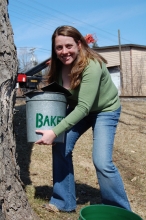
While March means basketball for many people, for Evelyn Baker it has another meaning entirely.
“It’s maple madness,” she told me shortly after I arrived at Baker’s Maple, the Bainbridge sugar house owned by her son Reed. And she wasn’t kidding.
To say this is their busy season would be an understatement. Right now they are collecting sap from the 4,621 taps they have in Chenango County and parts of Delaware County every day. That includes 586 buckets, all emblazoned with ‘Baker’s’ in green, which are emptied by hand.
Reed and his staff struggle to keep up with the thousands of gallons of sap they get in every day, some of it from trees they own or “rent” (property owners are compensated in maple syrup, of course) and some from other producers who have more than they can handle. This last happens more than you’d think. While I was there, Reed sent his uncle out to collect 4,000 gallons from a farm in neighboring Delaware County who begged him to take it off his hands.
But of course collecting it all is just the beginning of the process which turns the sap, which is about 98 percent water, into the sweet syrup we all know and love. It’s a lengthy process, and a hot one. (The place is like a sauna when the furnaces are burning.)
Reed and his crew spend as many as 18 hours a day boiling the sap down, at a rate of 800 gallons an hour. Depending on the sugar content, it takes roughly 40 gallons of sap to make one gallon of the finished product.
Yes, that’s a lot of raw material for a fairly small yield. Reed said he considers himself lucky when sap comes in with a 3 percent sugar content, rather than the usual 2. What accounts for the difference? According to the maple expert, sugar content depends largely on where the sap comes from. If it is from trees in a wooded area, where they tend to grow taller and have smaller crowns, the sap typically has a lower sugar content. Sap from stand-alone trees, with large crowns, tend to have a higher sugar content.
While Reed’s sugarhouse contains more than $100,000 worth of equipment which automates the process, it still requires constant monitoring. Samples are taken, temperatures are recorded and there is even a bit of stirring required to ensure that the finished product has the right sugar content – approximately 66 percent. At that point, it is finally maple syrup.
The maple goodness is siphoned off into 30-gallon drums to be later bottled, or used to make one of the other fine maple products Baker’s is known for. Maple cream, maple jelly, granulated maple sugar, maple coated nuts and, of course, maple sugar candy are some of the products you can buy in the Baker’s Maple store or from their website, www.bakersmaple.com.











