What do you call a person who can hold their breath for at least two and a half minutes, hang from a railing without regripping for three minutes and can be considered a deadly weapon in a court of law? A black belt at Tribute Martial Arts.
Tribute Martial Arts owner and head instructor Ron Lewis is a fourth degree black belt in Tae Kwon Do and has spent the last 28 years practicing the art of combat and restraint.
“It’s not so much teaching someone how to fight, but giving somebody more than one option. Just because you know how to fight doesn’t mean you have to,” he said.
The Korean fighting style traces its roots back to the 9th century when competing kingdoms in the region began teaching special fighting techniques to often out-numbered soldiers as a way to make them more formidable.
The style incorporated many Asian philosophies of internal balance and control with Buddhist influences having its own code of honor and strict discipline.
“The jump kick, for example, was originally designed as a way of dismounting riders on horse back,” said Ron.
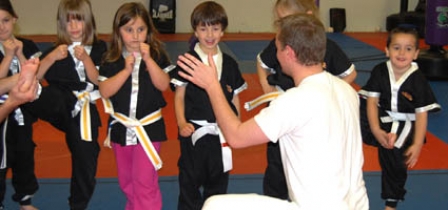
I was able to walk in Ron’s shadow as he instructed a large variety of classes at his Hale Street studio, from wrangling 5 and 6 years olds through an obstacle course to grappling with adults in fast-paced 30-second submission rounds.
“Maybe the most difficult thing for an instructor is evaluating each student’s learning pace and also knowing how they learn,” he said.
One of the first things to know, advised Ron, is that martial arts “isn’t just about kicks and punches;” it teaches students confidence, discipline and encourages a fit mind and body.
“We strive to instill in our students a sense of responsibility and respect for another,” he said.
We began the afternoon working with the 7 to 8-year-old class by practicing the beginning levels of the forms called “Hyung” in Korean.
“For the younger ones, we try to build coordination and listening skills,” he told me.
Ron complimented the younger students’ work ethic. “When they’re this young, they always seem to make their first attempt their best one. As you get older, you’ll notice more and more students pace themselves even when you’d rather have them make a full effort the first time around. They get smarter,” he joked.
The class finished up its day with a grappling game that focused on escapes. To explain grappling, imagine high school wrestling but without any rules – obviously there is no striking or pinching allowed, but twisting and even choking (which are high school wrestling no-no’s) are. The match is over when an opponent submits by tapping out. The younger group’s workout was not to that level of intensity, however.