I learned three very important things in my mini-apprenticeship to master potter Bill Troxell of Strong Stone Pottery and Gallery 3-2-1. No, make that four.
First and foremost, I learned that pottery is just as much a science as it is an art. Secondly, atmospheric conditions are highly influential in the ceramic process. Third, to be a successful potter, you need to like playing with fire as well as clay. And lastly, newspapers (especially those of competitors) are fairly toxic when burned.
When Bill and his wife Diane invited me to spend a Sunday afternoon with them at their studio and gallery outside of Oxford, I was thrilled. Here, I thought, was a chance to redeem myself for the hideous clay creations I produced in all those grade school art classes.
Unfortunately, the weather didn’t really cooperate. So instead of glazing and firing my own piece, I assisted Bill. Which, I’ll be honest, was probably a good thing.
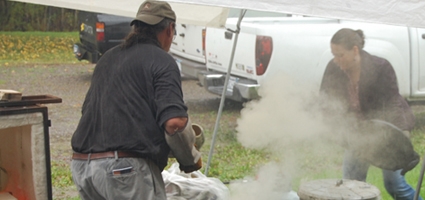
Since we would be firing outdoors, Bill had erected a canopy to protect both his portable raku kiln and us from the rain. He built the compact, propane-fueled kiln last year for demonstration purposes and hopes to use it with schools in the future.
The kiln’s design allows Bill to fire pieces in about an hour, which makes it perfect for explaining the physical and chemical changes that occur during the ceramic making process. This quick-fire technique produces decorative pieces of art as opposed to the production pieces that are the mainstay of the Strong Stone studio.
There is nothing low-tech about this piece of equipment. Its construction actually involved rocket science. Instead of the fire brick normally used to insulate kilns, Bill used a space-age fabric that looks deceptively like cotton batting. It happens to be the same material used on the space shuttle to protect against the intense heat encountered re-entering the earth’s atmosphere.
Despite the kiln’s humble appearance, it packs a big punch. When I arrived, it had been at “low candle” for approximately 15 minutes and was at around 1,200 degrees Fahrenheit, well on its way to the target of 1,800 degrees.
During the hour or so that it takes to fire the pieces, Bill keeps a close eye on the temperature and watches the behavior of the glaze. He can tell when they are “done” by the texture of that glaze. Under his tutelage, I could too.
Bill told me that part of the beauty of this extreme firing process is that manipulating certain variables can often yield unpredictable results.
The process of reduction, or removing oxygen from the kiln environment, is one of the techniques he uses to accomplish this. When air is cut off, the fuel is starved of the oxygen it needs to burn. In its desperation, it begins to extract oxygen from the glaze itself, causing permanent chemical changes to the color and texture of that glaze.
But Bill wasn’t satisfied with just cutting off the air. No, this is when we started playing with fire. He removed the pieces one at a time and placed them in a barrel filled with a “combustible” – where they actually combust, as in burst into flame, on contact. This took the reduction process, and my awe of this guy, to a new level.