Jacking up the tire was worth a try. It was too late to have a mechanic fix the leak, and if I took pressure off the wheel, perhaps enough air would remain by morning to allow me to drive to a tire shop instead of mounting the spare myself. Unfortunately, the wheel gave out a persistent hiss all evening, and by the next morning the tire was as soft as a marshmellow. Postponing labor this time hadn’t paid off, but after getting the spare in place, I realized I might as well resume plans to backpack North Cascade National Park’s Copper Ridge and worry about patching the punctured tire later. I felt guilty about leaving my Jeep sitting wounded in northern Washington for three days, but sometimes the itch to hit the trail overrides my sense of empathy.
My concerns about the Jeep mirror those that I have about my own aging body. For countless summers I have thrown myself into rough environments and precarious situations, and so far I’ve managed to avoid major injuries … no broken bones, scars or heavy bleeding. I have also miraculously kept the Jeep free of dents despite a decade of maneuvering down boulder-strewn mountain roads and through densely forested campsites. Both our physiques are dusty, but in stellar condition. It’s the internal parts that are wearing out.
The ligaments and tendons holding my joints together have torn and frayed over the years from overuse, and those connective tissues don’t heal very easily. As I ascended 2,500 feet with a heavy pack to Copper Ridge, a triple-layered knee brace and hiking poles helped keep the strain from further damaging my dodgy right knee. But these protective measures continued to have debilitating side-effects. The braces chafed my skin enough to leave raw and bloody lines across the back of my knee, and the hiking poles worsened a chronic case of “tennis elbow,” leaving my right arm weak and painfully sore. And I don’t even play tennis.
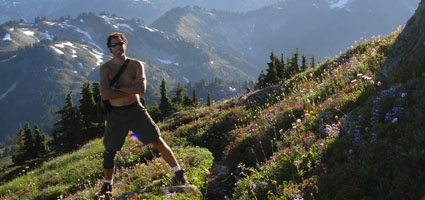
The prescription for recovering from all these repetitive injuries included rest, but I found it impossible to remain in the lowlands when it was summertime and the beauty of the high country lay within reach. Here in the North Cascades, the wildflowers were at their peak, and I witnessed bears wandering through the vibrant alpine meadows, feeding on the fresh shoots of plants that had only recently emerged from beneath a blanket of snow. Clouds swirled about my campsite on Copper Ridge at sundown, alternately enveloping and revealing a stark vista of barren glaciers, treacherous ridgelines, and bottomless valleys. The dance of vapors across my vision was like the fluttering of a magician’s cape, cloaking the mountains but occasionally rising with a grandiose flourish to unveil the tallest peaks of all – sharp-toothed Mt. Shuksan and the colossal volcanic summit of 10,781-foot Mt. Baker. No egalitarianism among mountains here… this land was ruled by giants.
Under the steady gaze of these titans, I ventured further along Copper Ridge the following day and took a route to the top of seldom-climbed Copper Mountain that was used more by mountain goats than humans, as evidenced by the tufts of white fur that clung to rock outcroppings and branches. The piercing whistles of marmots cried foul when I passed through the rodents’ territory… or perhaps they were warning me of the dangers ahead, for the ridgeline walk soon narrowed to become a knife-edge scramble. As I walked across a wide, tilted slab coated with fine gravel, my shoes suddenly lost traction, and I slipped. If there hadn’t been an evergreen branch to my left that I could quickly latch onto, nothing would have stopped me from swiftly tumbling down the slab and hurtling off the cliff at the far end. Instinct and luck carried the day; no broken bones, just a near heart attack.