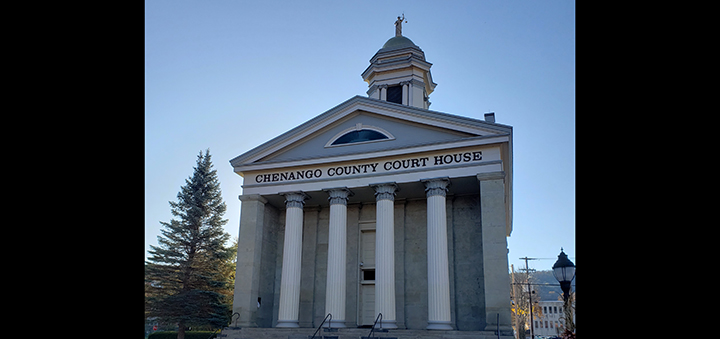
NORWICH – The outgoing chair of the Chenango County Planning and Development Board said last week the organization has been underused and is not complying with New York Sate General Municipal Law.
“We want to be asked to study things for the Board of Supervisors. They should, ideally, be pitching more to us,” said Kenneth Ryan, chairman since 2003 and a board member representing Oxford since 1999.
Specifically, Ryan said state law requires the Chenango County Planning and Development Board to review and comment on highway construction projects, such as the 32B Halfway House bridge project.
“By state law, we have to review all new highways being built. We don’t want to be bullheaded about it. It may be not natural for them, but, tactfully, we should tell them,” Ryan said.
Supervisor Linda E. Natoli, who, as chair of the county’s Planning & Economic Development Committee sits on the all-volunteer board, suggested it “would save time” if supervisors used the group “as a resource.” However, she suggested approaching standing committees first.
“I agree. The Planning Board is being wasted,” Natoli said, adding later that she wasn’t sure whether or not supervisors “really want us to do our job.”
“I’ve been very encouraged and impressed with your commitment to making Chenango County a better place to live, and how you all drag out here at 8 a.m. for this meeting every month,” she said.
Natoli also suggested that the group present an annual report before the board of supervisors meeting in March.
David C. Law, R-Town of Norwich, the only other county supervisor on the planning board, suggested two projects the board should take up: making Cook Park in Greene profitable and opening Upper Ravine Road in Norwich to support residential development.
“Both would be good projects for the board to look at,” Law said.
The Chenango County Planning and Development Board’s mission statement says it is to assist in county development “by leading and facilitating a planning process that informs and guides municipalities and the public.” Consistent with Chenango County’s 2020 Vision Commission findings, it is guided by the desire “to improve the quality of life by keeping vital economic growth in harmony with the rural character of the county and the environment.”
Municipal law charges the organization to review certain planning and zoning actions in local municipalities. The reviews, called 239s, may result in one of several outcomes: approval, approval with recommendations, approval with conditions, disapproval or no action. In 2007, the board reviewed 36 projects throughout the county, approving all but one. Comments, conditions or concerns were attached to all of the applications.
The board is also responsible for adopting a comprehensive plan.