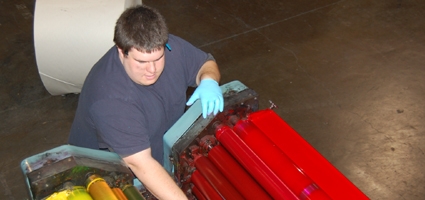
“That’s what I like to see,” said Sun Printing employee Dan Guyer, laughing as he walked by, pointing out a large glob of thick, black print ink on my arm. I hadn’t noticed it; too busy changing the plate on the press for yesterday’s front page of The Evening Sun. Turns out, as I discovered later when my shift at the pressroom ended, that the ink wasn’t just on my arm, but smeared all down the front of me and on my face, too (I wondered why Guyer was laughing so hard). It looked like I lost a fight with a pair of shoe-polished binoculars. But, after a scrubbing with a little pumice soap and scarfing down a glazed donut in the break room, my ego didn’t feel as bruised.
That was my initiation into the club at our sister company on Borden Avenue. And it was all part of a day’s work in the pressroom.
Before Wednesday, I thought all the magic of the newspaper happened at my desk every morning. I had often wondered, sitting in my cubicle, hacking away at my keyboard, sometimes Googling my name to see if it got any hits, “What would this place do without me?” Little did I know that my role at The Evening Sun is minimal compared to what these guys do.
It all starts around 7 a.m. with Mark Miller and “Darkroom” Dave Montague. They turn the pages my boss, Evening Sun Editor Jeff Genung, creates on a computer across town each morning into the plates that make the pages you read every day. So basically they take something that’s not real – a series of codes and electronic pulses that get sent through a big wire and make pictures and words on a computer screen – and turn it into something real – a sheet of aluminum that, when splashed with ink and rolled on newsprint, makes a newspaper. It’s a complicated process that involves a lot of expensive machinery that I wasn’t allowed to touch. The most important of which, I was told, is a thing called the “image setter.” It’s the most expensive, important and temperamental of the machines that I had to keep my hands off. It decides, depending on how many sacrifices its offered, whether or not our paper will be in color on any given day. Occasionally, if it’s not happy with the offering Miller and Montague place before it, it shuts down and we have to go to black and white.
“That’s my biggest nightmare,” said Miller.
From there, Pressroom Manager Tim Ryan and his four-man crew – Guyer, John Record, Don Prosser and Rodney Brewer – take the plates from the darkroom, put them on the press, ink them up and go. That also is a Cliff’s Notes version. From an outsider’s perspective, it looks like five guys running around in a scene from Charlie Chaplin’s “Modern Times.” In reality, it’s a complicated system of checks and balances.
“A lot of people don’t realize how sophisticated printing really is,” said Ryan.
I do now. It’s a whirling dervish of knob twisting, ink adjusting, water adding, lever pulling, paper changing, bell ringing, and newspaper stacking. And a lot of it. Sun Printing goes through 60 to 70 tons of newsprint a month. That’s roughly 45,000 newspapers and publications a day (aside from The Evening Sun, the company also prints seven Pennysavers, including Norwich and Sidney, as well as The Gazette, Tri-Town News, Chenango American, Oxford Review-Times, Sherburne News, and Cooperstown Crier).