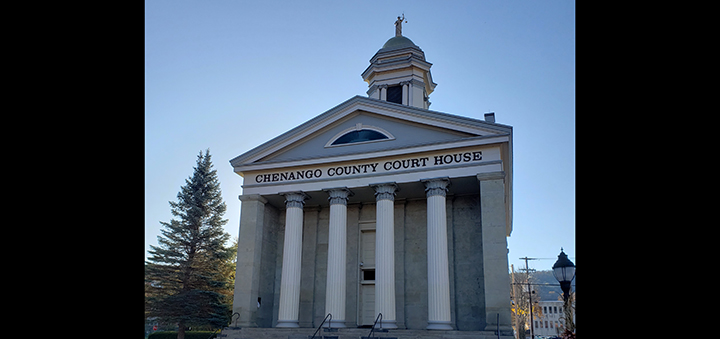
NORWICH – Three representatives from the New York State Office of Real Property Services were repeatedly questioned about Chenango County’s dropping equalization rates during a Nov. 13 presentation before the Chenango County Board of Supervisors.
They were invited to explain where rates come from and to educate town supervisors about the roles played by their local assessors in determining them. Several town assessors were also invited and attended.
The Office of Real Property Services (ORPS) sets equalization rates across the state by measuring the relationship of locally assessed values to the region’s real estate market. The assessed value divided by the market value equals the equalization rate.
The rate, which is certified every year, is what’s used to calculate school and property taxes. In order to maintain equality amongst taxpayers – and to abide by real property tax law – the state’s office urges towns to keep assessments as uniform as possible.
One third of New York is reassessed in any given year, and half of the state maintains a 100 percent equalization rate. Chenango County’s towns range from 100 percent (New Berlin) to 47 percent (Pitcher). Most towns have dropped over the last five years and are somewhere in the 60s percentile. All but the Town of Norwich (currently at 53 percent) saw there rates drop from 2006.
Through their questions, a handful of town officials complained that the rising number of real estate sales in Chenango County - the buyers of which have been paying much higher prices than assessments - should be tempered by its under-populated, rural and poor character.
“Is that market’s value determined by sales? Is that all you use? Do you use sales and curb it with anything if there is a blip for some reason?” Dennis Brown, D-Pharsalia, asked.
County Treasurer William E. Evans asked, “What is the definition of our market? We are poor, rural upstate county.” Evans also questioned whether ORPS’ staff cutbacks have made it difficult for them to know what’s going on in Chenango County.
Earlier this month, he also told members of Chenango County’s Finance Committee that town assessors “are right to value the area lower to keep fair within the framework of their town.”
Town of New Berlin Supervisor Ross Iannello, whose town has maintained a 100 percent equalization rate, questioned what happens when sales drop off. “If not many (sales) in a local market, then what? How does that impact the schools?”
ORPS representative Jeff Bartholomew said that recorded sales, even astronomical ones, have to be used if there is a trend. “We try to capture enough sales to determine market value,” he said, adding later that valuing Chenango County, in particular, hasn’t been easy.
“We try to keep values accurate because it’s the fairest way for all property owners,” he said.