I wanted something obscure, something not many people had ever tried or even thought of trying and after spending a day in the shoes of a funeral home director, I think I hit the mark.
My first five minutes ...
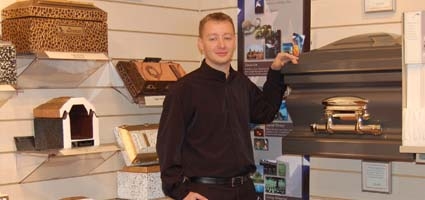
Local manager and R.J. Fahy Funeral Home Director, Michael C. Wright, graciously allowed me to tag along through one of his afternoons a few weeks ago. Within five minutes of our introduction, I jumped into the company van along side a body kept in a long cardboard box and headed off to the crematorium.
The delicate art of a funeral director
As one might imagine, the job takes some getting used to. Death is a very emotional and personal topic for everyone. A great deal of Mike’s efforts went into easing the burdens of the recently bereaved.
Mike and most funeral directors are the hub at which nearly all other untimely considerations intersect. The family makes their request and then it’s the director’s job to contact clergy, cemetery personnel, consult with close relatives and handle the logistics.
Mike always answers his phone. “I don’t like answering services,” he said. Whenever you call Fahy Funeral Home, the phone rings straight to him no matter the day or time. “It takes a lot of effort but it’s just something I refuse to not do,” said Mike.
During our day together, while traveling to meet the last living relative of a man who had recently passed away, Mike contacted several ministers and clerics via cell phone. Many had scheduling conflicts and slowly the art of the funeral director became clear, make sure everything runs smoothly ... and on time.
Cremation: Ashes to ashes and dust to dust
As I said, the first task of the day was cremation. The bodies, especially for those facing economic considerations or asking for cremation, are moved from one location to another in a cardboard box or mock casket made of a fiberboard material called embossed doeskin. The crematorium is operated by another local funeral home in Morris, the Johnston Funeral Home. William “Ted” Johnston operates the home along with a cremation facility across town.
The three of us gently slid the body out of the van and onto a cart. Ted explained what happens next. It takes an hour for the ovens to heat up before a body can be placed inside. New York State requires the temperature of incineration be above 1800 degrees Fahrenheit. Afterward, the remains mostly bone fragments are ground into a fine dust by a special machine and mixed with the ashes in an urn. A minute residue of ash and dust lingers on some of the equipment as complete control of such fine material is almost impossible.
Ted explained that in an oven at 1800 degrees, a body has heat and flame forced over it through a specially design ventilation system in the oven. Different bodies take different times to disintegrate, but most take about two to four hours, depending on body size and density.