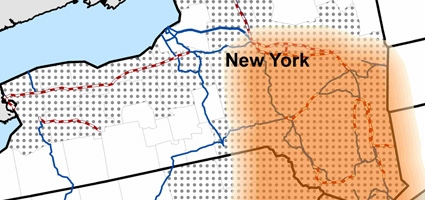
WASHINGTON – Most of the state and the entire length of New York Regional Interconnect Inc.’s proposed power line now rests in one of the two “National Interest Electric Transmission Corridor” designations announced by the U.S. Department of Energy Tuesday.
The designations were guided by the 2005 Energy Policy Act and finalized without much change after draft versions were created in April.
The energy department created a “Southwest” and “Mid-Atlantic” corridor, both encompassing two of country’s most populated and energy constrained areas, its report states.
Inside the corridors – which cover all or part of 10 states in total – the Federal Energy Regulatory Commission (FERC) will have unprecedented authority to review power line projects that a state has either denied or failed to review within one year.
The “Mid-Atlantic” corridor stretches from northern Virginia to northern New York state, where it covers 47 of 62 counties. <a href="http://www.evesun.com/topics/news/NYRI/">NYRI</a>’s project would run through eight of those 47 counties, including Chenango. While most of those counties are not constrained, they can aid in energy being brought to the places that are, the department says.
NYRI opponents fear the corridors unnecessarily undermine state authority and open a door for NYRI to slip through if it’s denied.
“It undermines our state’s existing, forward thinking energy philosophy by imposing the federal government’s view of what should be done upon us,” said Hubbardsville resident Chris Rossi, the co-chair of the citizens group Stop NYRI. “It’s really frightening.”
NYRI’s project was deemed unnecessary in September by the state’s electricity grid operator, which claimed in an annual report that there were more than enough solutions to meet New York’s energy needs.
In all, the Mid-Atlantic corridor encompasses counties in Ohio, West Virginia, Pennsylvania, New York, Maryland, Virginia, and all of New Jersey, Delaware, and the District of Columbia. The Southwest corridor blankets parts of southern California and Arizona.
Both corridors will encourage state’s to take “prompt” measures to meet the nation’s growing energy needs in the coming years, Secretary of Energy Samuel W. Bodman stated in a press release Tuesday.
“These National Corridors serve as an important indication by the federal government that significant transmission constraint or congestion problems exist,” Bodman said. “The goal is simple – to keep reliable supplies of electric energy flowing to all Americans. By designating these National Corridors, we are encouraging stakeholders in these regions to identify solutions and take prompt action.”
Assistant Energy Secretary Kevin Kovelar said the policy doesn’t take away a state’s rights, but rather gives the federal government a chance to step in if it fails to take prompt action.
“States will retain their primary responsibility” as siting authorities, Kovelar said.
If FERC does take over a power line review, Kovelar assured reporters that the utilities or companies proposing them would not be given a free pass.











