Municipal infrastructures, such as street signs, are usually taken for granted. Most residents know where they are going and how to get there, so they just drive to their destinations without reading the street signs. The drivers who do read them are from some place else. Street signs are the first things visitors pay attention to when entering a city. Missing or defective signs do not reflect well on a municipality. Here in the City of Norwich, drivers are frequently stopping to ask me where some place is, usually because of the occasional absence of some signs or the peculiar policy of having only one street labeled at many intersections.
Some signs look old and others look new, so I was under the impression that the replacement of street signs simply followed economic cycles of boom and bust and the capricious interests of the Common Council. But Police Chief Joe Angelino explained that street signs are mandated to comply with specifications in the State of New York Manual of Uniform Traffic Control Devices, which change over time. This means that street signs can be classified by their appearance and the dates of their erection can be determined. That is, street signs reveal their history. To us infrastructure fans, this is a startling breakthrough.
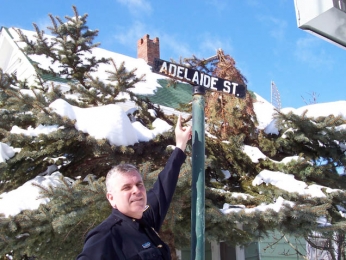
In the photo, Joe is showing me the Adelaide Street sign on the northwest corner of the intersection with Sheldon Street. This is the oldest street sign in the City that is still in service. It was erected before 1955. It has white letters on a black background with no border.
Street signs were the responsibility of the Police Department until about 1988-89. Then the Department of Public Works (DPW) took over. Joe has kept up with the history of these signs. He shares with us the key to deciphering them. White letters on a black background and no border are the oldest. White letters on a black background with a white border come next. These are stamped steel, like license plates. Only three remain: Sheldon and Silver, Gold and River, and the entry to Willard Court. Signs in the downtown business district also have raised white letters on a black background with a white border, but have a distinctive old-fashioned design. They were erected in 2005.
Black letters on a white background stem from the urban renewal era (1960 - 1970s). Only one remains, at Hale Street and Midland Drive.
White letters stamped on a green background appeared in the early 1970s. They were reserved for streets that intersected state highways. The letters contain tiny glass particles to reflect headlights, possibly a state requirement. An example stands at the northeast corner of Mitchell and North Broad streets but others can also be found along Route 12 (North and South Broad streets), Route 23 (Plymouth, Pleasant, and Rexford streets), former Route 319 (West Main Street), and Arterial Route 990L (East Main Street).