Batteries produce electricity from chemical interactions. They come in two major types: primary, which produce electricity, and secondary or storage, which have to be charged. Primary batteries themselves come in two types: dry cells and wet cells. Dry cells can be handled without fear of spilling their contents. Wet cells are vats of liquid; they are not widely used anymore. Thus they are interesting pieces of history.
The name “battery” was originally used for a group of cells, deriving its meaning from the military, where an artillery battery is a group of guns. Batteries have been around for two centuries. Alessandro Volta (1745-1827) is credited with inventing the first battery in 1800. However, using chemicals to produce electricity has its origins in the earliest historic times, long before electricity was understood.
Thomas Alva Edison (1847-1931) developed several batteries. His black copper oxide and zinc in caustic soda (sodium hydroxide) became the one used by railroads to power their signals. Edison’s wet cell consisted of a cylindrical glass jar 6 inches in diameter and 10 inches high. It was covered with a porcelain lid from which two zinc plates and two copper oxide plates were hung. The zinc was negative and the copper oxide positive. The aqueous solution of sodium hydroxide was separated from the air by a layer of petroleum oil to prevent evaporation of water and absorption of carbon dioxide.
Readers who took science in school probably remember battery jars, because they had so many uses. They are called by that name because originally they were jars used for batteries. In biology labs we used them to raise plants, animals, and microbes.
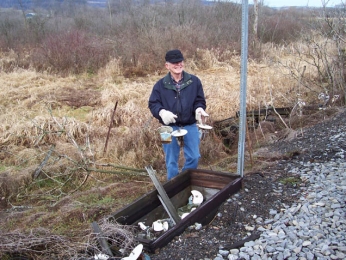
Railroads used to have electrical signals along their tracks. Beside each signal was a battery box, usually made of wood, but some were made of concrete. We have two concrete boxes still remaining in the City of Norwich and I hope they will be conserved. The battery boxes appear to have contained 14 wet cells. Each cell produced 0.8 volts.