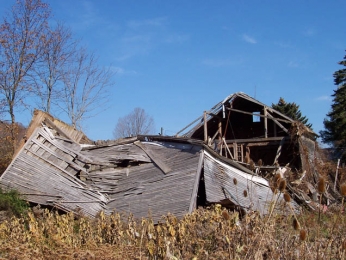
See that old dilapidated building in the photo? To me, it is a thing of beauty, a fortuitous kinetic sculpture which moves over time as it seeks its lowest energy state. If its progressive demise could have been captured with time-lapse snapshots, it would have shown all the restless stages in its staggered collapse.
I identify with such wretched ruins because I do have snapshots of my own protracted life cycle. My waxing and waning are, in retrospect, satisfying because I have persisted this long. Sometimes I feel exactly how that poor old building looks. Aches and pains be damned; full speed ahead, into the looming abyss of inevitable doom.
Of course, not everyone agrees with my aesthetic values. Most folks believe that such debris should be hauled away to the dump. So too, does a youth-oriented society believe that we old geezers should be hauled away to a nursing home on our way to the graveyard. However, as a militant geriatric, I push back because I like old stuff.
Fortunately, other folks believe that old buildings should be preserved. But, what means “preserve?” Strawberries are preserved when smushed and cooked into a tasty, sticky goop. Cucumbers are preserved in pickling brine. Frogs are preserved in formaldehyde. How do you preserve a building? First, by taking good care of it, but even then it requires repair. It may even need some rebuilding. The trouble is that this kind of preservation requires money. Moreover, when you rebuild a historical building, you no longer have a historical building. You have what looks like a historical building.
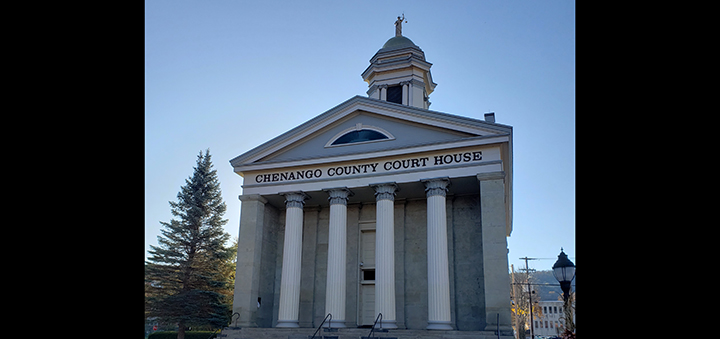
The words “historical” and “historic” need clarification. Anything old is historical. I am historical. A historic thing is not merely old but is also famous. Putting money into preserving a historic building may indeed be a wise investment. Putting money into a historical building may be foolishly pouring money down a one-way rat hole. Making the distinction is critical. Then too, it all depends on how famous the building is. Our county courthouse is indisputably historic and fixing it up was truly a wise choice. That thing of beauty in the photo was probably not famous and letting it go may have been a practical response.